

 en
en cs
cs da
da de
de it
it pl
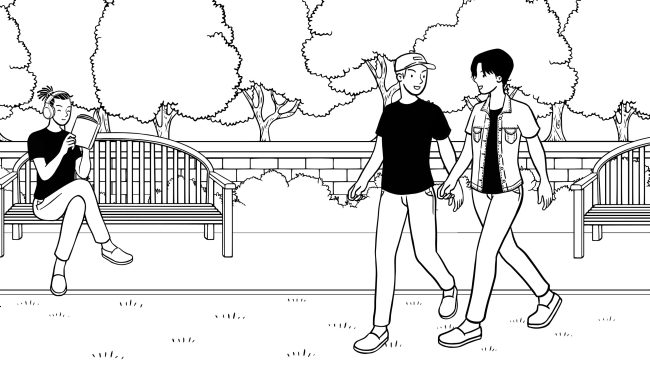
plThe pattern yìbiān… yìbiān… 一边/一邊……一边/一邊…… ‘… while … at the same time’ expresses two simultaneous actions performed by the same subject or, sometimes, by different subjects. It forms a coordinate compound sentence composed of two parallel clauses, each carrying information of equal importance.
Structure
Basic form
The pattern yìbiān… yìbiān… 一边/一邊……一边/一邊…… ‘… while… at the same time’ is used to express two actions occurring simultaneously. These actions are usually performed by the same subject, although in some cases they may be performed by different subjects.
Each adverb yìbiān 一边/一邊 is followed by a verb or a verb phrase, such as a verb with an object or a verb phrase introduced by a modal verb.
Note that, when both verbs are monosyllabic and share the same subject, yī 一 can be omitted, forming a four-character expression.
Negation
The pattern yìbiān… yìbiān… 一边/一邊……一边/一邊…… itself cannot be directly negated. However, it is possible to be negated with combination of a negation adverb and a modal verb.
Questions
To form a yes–no question, the question particle ma 吗/嗎 can be added at the end of the sentence.
Functions
1. Yìbiān… yìbiān… 一边/一邊……一边/一邊 expressing simultaneous actions
The pattern yìbiān… yìbiān… 一边/一邊……一边/一邊…… ‘… while… at the same time’ emphasizes that the subject performs two actions at the same time, highlighting their simultaneity. For this reason, the choice of verbs is crucial: both actions must be compatible and able to occur simultaneously. In most cases, the verbs describe concrete, observable actions or behaviours.
In many cases, the order of the two simultaneous actions is reversible without affecting the meaning.
However, when there is a logical dependency, for example one action enables or frames the other, such as “counting the steps while running”, the order is not reversible.
Sometimes, the simultaneity expressed by this pattern does not refer to actions happening at the same moment, but to two activities carried out in parallel over an extended period of time.
Note that, the pattern yìbiān… yìbiān… 一边/一邊……一边/一邊…… cannot be used with verbs expressing will or psychological activity, or with verbs describing the subject’s identity or state, such as shì 是 ‘to be’, yǒu 有 ‘to have’ or dāng 当/當 ‘to serve as’.