
 en
en cs
cs da
da de
de it
it pl
plNumerals can be combined with commonly used time-related nouns such as nián 年 ‘year’, yuè 月 ‘month’, rì 日 ‘day of a month’, xīngqī 星期 ‘week’, diǎn 点/點 ‘o’clock’ and fēn 分 ’minute’ to express dates and times.
Structure
1. Dates: year – month – day
When expressing dates, numerals are typically placed before the time words nián 年 ‘year,’ yuè 月 ‘month,’ and rì 日 ‘day of a month,’ following an order from larger to smaller units. In informal spoken Chinese, the word hào 号/號 ‘day of a month’ is commonly used in place of rì 日 when referring to dates. In dates, when a zero is needed for indicating years, the character líng 〇 ‘zero’ is typically used instead of líng 零 ‘zero.’
When asking about dates, it is common to use interrogative phrases such as shénme shíhou 什么时候/什麼時候 ‘when’, jǐ yuè jǐ haò 几月几号/幾月幾號 ‘which date’, nǎ yì tiān 哪一天 ‘which day’ or nǎ yì nián 哪一年 ‘which year’ to form questions. The following are typical ways to use these question words to ask about dates or times.
2. Days of the week
When indicating the days of the week, the numbers yī 一 ‘one’ to liù 六 ’six’ are placed after the time word xīngqī 星期 ‘week’ to indicate Monday to Saturday. Sunday is expressed as either xīngqīrì 星期日 or xīngqītiān 星期天, the former being more formal.
Zhōu 周/週 ‘week’ can be used in place of xīngqī 星期. The numbers yī 一 ‘one’ to liù 六 ’six’ can also be added after zhōu 周/週, as in zhōuyī 周一/週一 for Monday. However, when using zhōu 周/週 in a word for ‘Sunday’, only zhōurì 周日/週日 is acceptable.
| Monday | 星期一 | xīngqīyī | = | 周一 | 週一 | zhōuyī |
| Tuesday | 星期二 | xīngqīèr | = | 周二 | 週二 | zhōu‘èr |
| Wednesday | 星期三 | xīngqīsān | = | 周三 | 週三 | zhōusān |
| Thursday | 星期四 | xīngqīsì | = | 周四 | 週四 | zhōusì |
| Friday | 星期五 | xīngqīwǔ | = | 周五 | 週五 | zhōuwǔ |
| Saturday | 星期六 | xīngqīliù | = | 周六 | 週六 | zhōuliù |
| Sunday | 星期日 | xīngqīrì | = | 周日 | 週日 | zhōurì |
| Sunday | 星期天 | xīngqītiān |
3. Complex dates
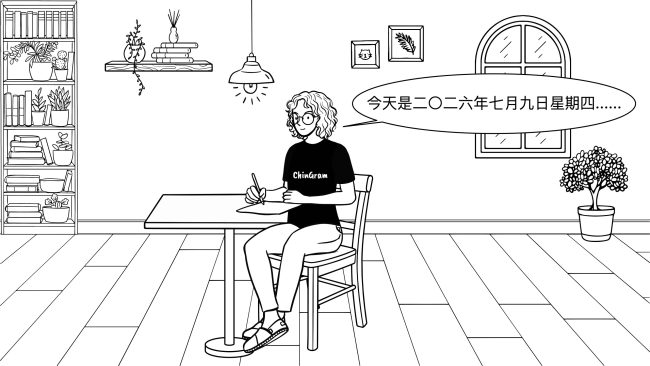
When expressing a full date that includes the day of the week, xīngqī 星期 follows the year, month, and day.
When asking about the day of the week, the question word jǐ 几 ‘how many’ is typically placed after xīngqī 星期 or zhōu 周/週, as in xīngqī jǐ 星期几 /星期幾 or zhōu jǐ 周几/周幾.
4. Commonly used time expressions
When expressing a temporal order, the time expressions are commonly used, such as jīnnián 今年 ‘this year’, zuótiān 昨天 ‘yesterday’, shàng ge xīngqī 上个星期/上個星期 ‘last week’ and xià ge yuè 下个月/下個月 ‘next month’.
The words nián 年 ‘year’ and tiān 天 ‘day’ are used similarly. Both functioning as measure words, they do not require an additional measure word. Examples include yì nián 一年 ‘one year’ and sān tiān 三天 ‘three days’.
In contrast, yuè 月 ‘month’ and xīngqī 星期 ‘week’ do not serve as measure words. Therefore, they must be preceded by the measure word ge 个/個 as seen in yí ge xīngqī 一个星期/一個星期 ‘one week’ and liǎng ge yuè 两个月/兩個月 ‘two months’.
The following are examples of commonly used time noun sequences, which illustrate the structural difference between the two groups mentioned above:
| 前年 | 去年 | 今年 | 明年 | 后年/後年 |
| qiánnián | qùnián | jīnnián | míngnián | hòunián |
| the year before last | last year | this year | next year | the year after next |
| 前天 | 昨天 | 今天 | 明天 | 后天/後天 |
| qiántiān | zuótiān | jīntiān | míngtiān | hòutiān |
| the day before yesterday | yesterday | today | tomorrow | the day after tomorrow |
| 上上个星期/上上個星期 | 上个星期/上個星期 | 这个星期/這個星期 | 下个星期/下個星期 | 下下个星期/下下個星期 |
| shàngshàng ge xīngqī | shàng ge xīngqī | zhè ge xīngqī | xià ge xīngqī | xiàxià ge xīngqī |
| the week before last | last week | this week | nnext week | the week after next |
| 上上个月/上上個月 | 上个月/上個月 | 这个月/這個月 | 下个月/下個月 | 下下个月/下下個月 |
| shàngshàng ge yuè | shàng ge yuè | zhè ge yuè | xià ge yuè | xiàxià ge yuè |
| the month before last | last month | this month | next month | the month after next |
5. Time of the day
When indicating full hours, a number is placed directly before diǎn 点/點 ‘o’clock’ or diǎnzhōng 点钟/點鐘 ‘o’clock’. It is important to note that for two o’clock, only liǎng diǎn 两点/兩點 is acceptable, not èr diǎn 二点/二點.
To express minutes, a number is placed before fēn 分 ‘minute’. In spoken Chinese, fēn 分 can be omitted. When zero is needed in this context, the character líng 零 should be used.
For half hours, the word bàn 半 ‘half’ is often placed directly after diǎn 点/點 to indicate the half-hour mark.
Kè 刻 ‘quarter(hour)’ can be used in phrases yí kè 一刻 and sān kè 三刻, to indicate ‘a quarter hour’ and ‘three quarters of an hour’. These phrases are placed after diǎn 点/點.
When referring to minutes to the hour in Chinese, the word chà 差 ‘fall short’ is placed before or after the fēn 分 phrase. For example, chà liǎng fēn shí diǎn 差两分十点/差兩分十點 means ‘two minutes to ten’. This structure is most commonly used when the time difference is “five minutes”, “ten minutes” or a quarter.
The 24-hour clock is generally not used in Chinese. Instead, the part of the day is indicated before the hour. Commonly used phrases include:
- zǎoshang 早上 ‘(early) morning’ – usually before 8:00 a.m.
- shàngwǔ 上午 ‘morning’ – from around 8:00 a.m. to 11:59 a.m.
- zhōngwǔ 中午 ‘noon’ – around 12:00 p.m. to 12:59 p.m.
- xiàwǔ 下午 ‘afternoon’ – from about 1:00 p.m. to 5:59 p.m.
- wǎnshang 晚上 ‘evening’ – from 6:00 p.m. onward
The phrases listed above indicate the part of the day rather generally. However, speakers may differ in how they apply these terms. For example, some speakers may use zǎoshang 早上 for the entire morning.
Here are a few examples:
When asking about the time, the most common interrogative expression is jǐ diǎn 几点/幾點 ‘what time’ or jǐ diǎn jǐ fēn 几点几分/幾點幾分 ‘what time’.
Function
Indicating when an action or event takes place
Date and time expressions are used to indicate when an action or event takes place. The most typical position is immediately after the subject.
However, if the context requires emphasis on time, such as contrasting the timing of multiple events or highlighting chronological order, the time expression may also appear before the subject.
When asking about time, interrogative time expressions should not be placed at the beginning of the sentence.