

 en
en cs
cs da
da de
de it
it pl
plWhen talking about amounts of money, it is common to add the following monetary units after numbers: kuài 块/塊 ‘Chinese yuan (¥)’, máo 毛 ‘10 cents, ¥ 0.1’, and fēn 分 ‘1 cent, ¥ 0.01’. The word qián 钱/錢 ‘money’ can be added at the end of the phrase to make the meaning more explicit. When the context is clear, especially in informal spoken Chinese, the word qián 钱/錢 can be omitted. For example, ¥ 15.63 is shíwǔ kuài liù máo sān fēn (qián) 十五块六毛三分(钱)/十五塊六毛三分(錢).
In more formal or written contexts, such as in financial documents or on price tags in stores, the units yuán 元 ‘Chinese yuan (¥)’ and jiǎo 角 ‘10 cents, ¥ 0.1’ are commonly used. Sometimes, shop assistants will also use yuán 元 when talking to customers. The difference between yuán 元 and kuài 块/塊 is roughly comparable to the difference between “dollars” and “bucks” in American English.
| formal or written form | informal or spoken form | |
| ¥ 1 | yì yuán 一元 | yí kuài 一块/一塊 |
| ¥ 0.3 | sān jiǎo 三角 | sān máo 三毛 |
| ¥ 7.5 | qī yuán wǔ jiǎo 七元五角 | qī kuài wǔ (máo) 七块五(毛)/七塊五(毛) |
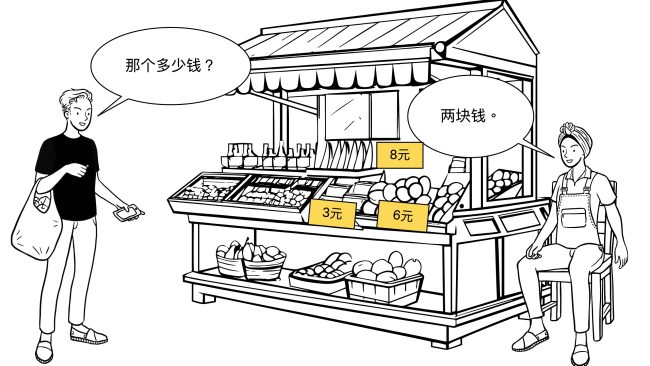
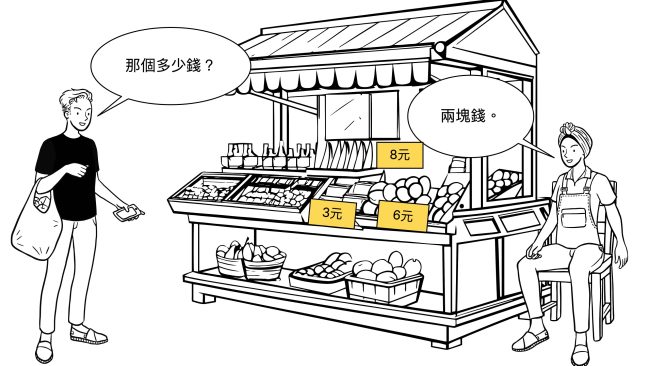
Structure
1. Asking “how much” with the phrase duōshao qián 多少钱/多少錢 ‘how much money’
2. Talking about an amount of money below 100
When a digit is missing, for example, when there’s no máo 毛 but there is fēn 分, líng 零 ‘zero’ is used to fill the gap.
3. Omitting máo 毛 and fēn 分 in amounts below 100
When the last unit of an amount is máo 毛 or fēn 分, it is often omitted. Note that when the smallest unit is “two”, èr 二 is used instead of liǎng 两/兩.
4. The use of líng 零 in amounts above 100
When a digit is missing, líng 零 ‘zero’ needs to be used to fill the gap.
Note that when talking about larger amounts of money that include both whole numbers and fractional parts, líng 零 can be inserted after kuài 块/塊 and before the fractional part.
In this context, líng 零 does not literally mean ‘zero.’ Instead, it functions like a bridge preceding the fractional part of the amount. For example, ¥100.37 is read as yì bǎi kuài líng sān máo qī fēn 一百块零三毛七分/一百塊零三毛七分, which can be understood as “¥100 plus 37 cents as a fractional amount.” ”.
5. Omissions in amounts above 100
When expressing a round number in amounts of money, such as ¥ 110, the item for the smallest unit is often omitted. Therefore, yì bǎi yīshí kuài 一百一十块/一百一十塊 can be reduced to yì bǎi yī 一百一. This is very common and natural in everyday conversation, especially when the context is clear. When the smallest unit is two, èr 二 should be used, not liǎng 两/兩.
Below are some examples: