

 en
en cs
cs da
da de
de it
it pl
plExplanations
Degree adverbs indicate the intensity of a feeling or the extent of a quality. Common degree adverbs include hěn 很 ‘very’, fēicháng 非常 ‘extremely’, tài 太 ‘too; excessively’, zhēn 真 ‘really’, duō(me) 多(么) ‘how; so’, and hǎo 好 ‘so; very’. They are usually used before adjectives or verbs that show a state or feeling, such as xǐhuan 喜欢 ‘to like’, xiǎng 想 ‘to want; to miss’, or pà 怕 ‘to fear’, but not before action verbs like qù 去 ‘to go’, chī 吃 ‘to eat’, or kàn 看 ‘to see; to watch’. All these degree adverbs strengthen the meaning, but each has a different strength, tone, and usage.
Structure
Basic structure
Degree adverbs usually appear before adjectives or verbs that they modify. The final particle le了 (le 了2) is often used with tài 太 in an exclamation sentence. Sentence final particle a 啊 is usually added at the end of a sentence when duō(me) 多(么), zhēn 真 or hǎo 好 are used to form exclamatory sentences.
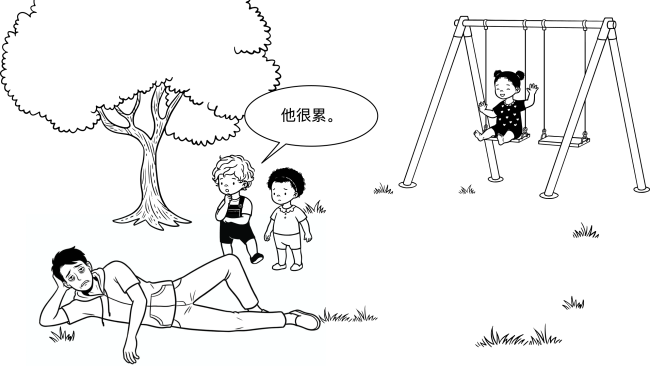
Note: The adverb hěn 很 can mean ‘very’, but in many sentences it mainly functions as a grammatical linker and does not fully keep its lexical meaning. In simple descriptive sentences, an adjective usually does not appear alone as a predicate. For a neutral sentence like ‘He is tired’, hěn 很 is added to make the sentence sound natural: Tā hěn lèi 他很累. In this use, hěn 很 is often unstressed in pronunciation and does not mean ‘very’. The meaning ‘very’ is only conveyed when hěn 很 is stressed. Sentences like Tā lèi 他累, with hěn 很omitted, sound comparative or contrastive, roughly meaning ‘He is (more) tired (than someone else / than expected)’.
Negation
These degree adverbs are typically not used in negative sentences, except for tài 太. In everyday speech, when expressing a moderate or mild negative degree ‘not much, not extremely’, speakers generally use patterns such as bú tài 不太 ‘not so’, bù zěnme 不怎么 ‘not very’ or bú shì hěn 不是很.
Bù 不 can also follow degree adverbs such as hěn 很, fēicháng 非常, and tài 太, but conveys a different meaning. In these cases, the construction does not mean ‘not so’ or ‘not very’. Instead, it expresses an intensified negative meaning, such as ‘strongly not’, ‘really not’, or ‘very un-X’. This usage occurs when bù 不 + adjective or verb already denotes a clear negative state (e.g., bù gāoxìng 不高兴 ‘unhappy’, bù shūfú 不舒服 ‘uncomfortable’, bù xiǎng 不想 ‘unwilling’), and the speaker intends to intensify the negative attitude or feeling.
Questions
Questions are typically formed by placing the question particle ma 吗 at the end of the sentence. The A-not-A pattern isnot used with degree adverbs.
However, the degree adverbs duō(me) 多(么) and hǎo 好 are not used in questions because they are usually used in exclamations rather than questions.
With adverbs
Scope adverbs such as yě 也 ‘also’ and dōu 都 ‘all’ usually appear before degree adverbs.
The same rule applies to temporal adverbs, such as yǐjīng 已经 ‘already’, yìzhí 一直 ‘always’, yǒushí 有时 ‘sometimes’, and gānggāng 刚刚 ‘just now’. The degree adverb usually follows the temporal adverb
With modal verbs
When a degree adverb is used together with a modal verb, the degree adverb usually appears before the modal verb.
Functions
1. Expressing high degree
The main function of these degree adverbs is to serve as an intensifier to express the high degree of the adjective or verb. They all express a high degree, but differ in strength, formality, and emotional tone.
Hěn 很 ‘very’: Neutral degree, often used to link subject and adjective even if no strong degree is intended. It also prevents a comparative meaning.
Fēicháng 非常 ‘extremely’: Expresses a stronger degree than hěn 很. It is closer in meaning to ‘very’ in English.
Tài 太 ‘too; excessively’: Expresses excessive degree. It is often followed by the final particle le 了 (了2) to create an exclamatory effect.
The final particle le 了 (了2) is omittable when there is a following sentence.
Zhēn 真 ‘really’: Often used to express the speaker’s emotion or subjective feeling. It is common in spoken Chinese and slightly informal. It is used to describe things that are real, present, or already known, but not future events or predictions.
Duō(me) 多(么) ‘so; very’: Used in exclamatory sentences, often with the final particle a 啊. In general, duō(me)多(么) is more emphatic and more common in written Chinese than duō 多.
Hǎo 好 ‘so; very’: In the pattern hǎo 好 + Adj./V. + a 啊!, it works as a degree adverb expressing intensity or emotion. It is used in spoken Chinese.
Note: Tài 太, zhēn 真, duō(me) 多(么) can not be used in indrect speech, and hěn 很, fēicháng 非常 are usually used instead.