

 en
en cs
cs da
da de
de it
it pl
plAdjective reduplication is a common grammatical feature in Chinese. Repeating an adjective creates a softer, more expressive tone. The repetition often makes the adjective sound more vivid or affectionate. Depending on the type of adjective, different reduplication patterns are used.
Not all adjectives can be reduplicated. There is no fixed rule for which adjectives can be reduplicated. Common adjectives that can be reduplicated include:
Monosyllabic:
cháng 长/長 ‘long’, duǎn 短 ‘short’, pàng 胖 ‘fat’, shòu 瘦 ‘thin’, dà 大 ‘big’, xiǎo 小 ‘small’, yuán 圆/圓 ‘round’, jiān 尖 ‘pointed’, shēn 深 ‘deep’, qiǎn 浅 ‘shallow’, gāo 高 ‘tall’, ǎi 矮 ‘short’, hǎo 好 ‘good’, kuài 快 ‘fast’, màn 慢 ‘slow’, lǎn 懒/懶 ‘lazy’, tián 甜 ‘sweet’
Disyllabic:
gāoxìng 高兴/高興 ‘happy’, tòngkuài 痛快 ‘joyful’, piàoliàng 漂亮 ‘pretty’, gānjìng 干净/乾淨 ‘clean’, zhěngqí 整齐/整齊 ‘tidy’, rènzhēn 认真/認真 ‘serious’, shùnlì 顺利/順利 ‘smooth’, qīngchǔ 清楚 ‘clear’, jiǎndān 简单/簡單 ‘simple, rènnào 热闹/熱鬧 ‘lively’, shūfú 舒服 ‘comfortable’, kāixīn 开心/開心 ‘happy’, kuàilè 快乐/快樂 ‘happy’
Structure
Basic form
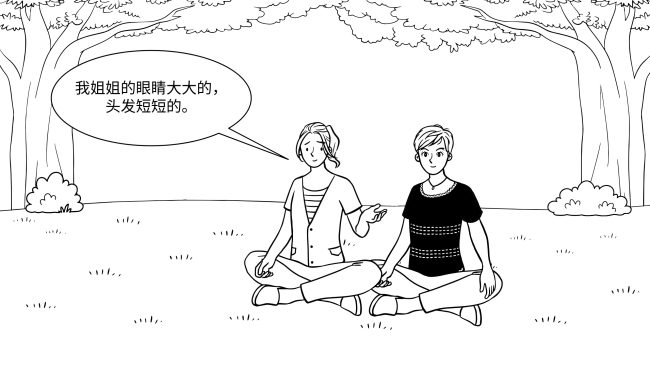
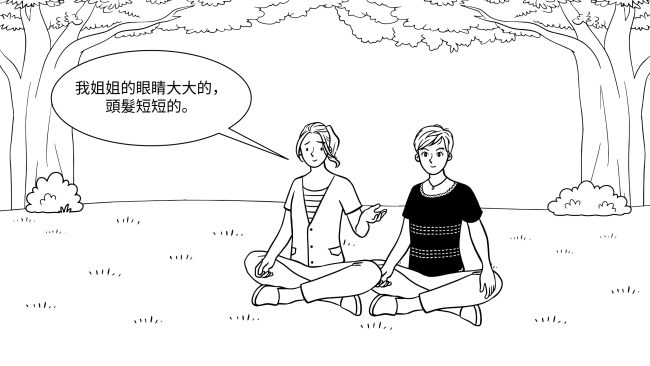
Monosyllabic adjectives can be reduplicated in the ‘AA’ form. They are preceded by de 的 when modifying a noun, and by de 地 when modifying a verb. The structural particle de 地 can be omitted when the monosyllabic adjective is reduplicated.
Disyllabic adjectives are reduplicated in the ‘AABB’ form. The same rule applies to the use of de 的 and de 地. After adjectival reduplication, 的 cannot be omitted, and 地 usually cannot be omitted either.
Negation
Reduplicated adjectives are usually not used with negation words like bù 不 or méi 没/沒. This is because reduplication often carries a positive or softened tone, while negation would disrupt the expressive or emotive function.
Questions
Yes-no questions are formed by placing the question particle ma 吗/嗎 at the end of a statement. A–not–A questions are not used with reduplicated adjectives.
With adverbs
Adverbs of scope such as yě 也 ‘also’, dōu 都 ‘both; all’, hái 还/還 ‘also; still’, yòu 又 ‘also; again’ can appear before a reduplicated adjective. When these adverbs are used, they are placed before the reduplicated form of the adjective.
Note: Degree adverbs such as hěn 很 ‘very’, fēicháng 非常 ‘very’, zhēn 真 ‘really’ or expressions such as jí le 极了/極了 and de hěn 得很 do not co-occur with adjective reduplication. This is because adjective reduplication itself gives the adjective a descriptive or emphatic effect.
With prepositional phrases
When a reduplicated adjective functions as an adverbial, it may appear before or after the prepositional phrase.
Functions
1. Expressing vividness or emphasis
Adjective reduplication makes an adjective sound more descriptive or emphatic, and therefore highlights its degree or impression. It is usually used for rhetorical effect, making the description sound more vivid and expressive.
2. Softening the tone
Adjective reduplication can make the tone milder, more affectionate, or more casual. It often adds a friendly or gentle feeling to the description.
Also check: Verb-reduplication (AA、A一A、A了A、ABAB)
3. Expressing speaker attitude
Adjective reduplication can be used to express the speaker’s affection and sense of intimacy. In informal contexts, adjective reduplication often conveys approval, appreciation, or a tone typical of child-directed speech.
Note: The difference between this sentence and Zhè ge háizi yǎnjīng hěn dà, zhēn kě’ài! 这个孩子眼睛很大,真可爱!is that hěn 很 + adjective gives a more objective and descriptive tone, expressing a neutral evaluation. In contrast, adjective reduplication adds a subjective and emotional quality, reflecting the speaker’s fondness towards the child.
4. Expressing manner
Some reduplicated adjectives can be used as adverbs to modify verbs.
5. Expressing temporary or limited states
Reduplication can describe a temporary, light, or short-term quality rather than a permanent one.