

 en
en cs
cs da
da de
de it
it pl
plLocation words are nouns that indicate direction or location. These words are commonly used to describe where something is located in relation to another object or place. Below are some of the most frequently used location words:
| Simplified character | Traditional character | Pinyin | Meaning |
| 上 | 上 | shàng | above, on top of |
| 下 | 下 | xià | below, under |
| 前 | 前 | qián | in front of |
| 后 | 後 | hòu | behind |
| 里 | 裡 | lǐ | inside |
| 外 | 外 | wài | outside |
| 左 | 左 | zuǒ | left |
| 右 | 右 | yòu | right |
| 旁 | 旁 | páng | beside, next to |
| 中 | 中 | zhōng | in the middle, center |
| 东 | 東 | dōng | east |
| 南 | 南 | nán | south |
| 西 | 西 | xī | west |
| 北 | 北 | běi | north |
The expression of compound directions such as “northeast” or “southwest” is according to a fixed pattern. The horizontal direction (east or west) is placed before the vertical direction (north or south). In English, by contrast, “north-” or “south-” typically comes first.
| Simplified character | Traditional character | Pinyin | Meaning |
| 东北 | 東北 | dōngběi | northeast |
| 东南 | 東南 | dōngnán | southeast |
| 西北 | 西北 | xīběi | northwest |
| 西南 | 西南 | xīnán | southwest |
These location words are seldom used on their own in spoken Chinese. Instead, they are usually combined with either the suffix biān 边/邊 or miàn 面 to form disyllabic location nouns. These disyllabic location nouns can be used to indicate direction or location. For example:
| Simplified character | Traditional character | Pinyin | Meaning |
| 上边 | 上邊 | shàngbiān | on top |
| 下边 | 下邊 | xiàbiān | underneath |
| 前面 | 前面 | qiánmiàn | front side |
| 后面 | 後面 | hòumiàn | back side |
| 里面 | 裡面 | lǐmiàn | inside |
| 外边 | 外邊 | wàibiān | outside |
| 左边 | 左邊 | zuǒbiān | left side |
| 右边 | 右邊 | yòubiān | right side |
| 旁边 | 旁邊 | pángbiān | beside, next to |
| 东边 | 東邊 | dōngbiān | east |
| 南边 | 南邊 | nánbiān | south |
| 西边 | 西邊 | xībiān | west |
| 北边 | 北邊 | běibiān | north |
Note that the disyllabic form of páng 旁 ‘beside, next to’ can only be pángbiān 旁边/旁邊 ‘beside, next to’; and the disyllabic form of zhōng 中 ‘in the middle, centre’ is always zhōngjiān 中间/中間 ‘in the middle, in between.’
A disyllabic location word is often attached to another noun, which refers to either a place, a person, or an object, and serves as a reference point for spatial location. Here are some examples:
| Simplified character | Traditional character | Pinyin | Meaning |
| 桌子上边 | 桌子上邊 | zhuōzi shàngbiān | behind the school |
| 学校后面 | 學校後面 | xuéxiào hòumiàn | back side |
| 教室里面 | 教室裡面 | jiàoshì lǐmiàn | inside the classroom |
| 老师旁边 | 老師旁邊 | lǎoshī pángbiān | next to the teacher |
Shàng 上, xià 下, lǐ 里/裡 and wài 外 can often be attached directly to a noun. Thus, zhuōzi shàngbiān 桌子上边/桌子上邊 can be zhuōzi shàng 桌子上, jiàoshì lǐmiàn 教室里面/教室裡面 can be jiàoshì lǐ 教室里/教室裡. However, this rule cannot be applied to all the monosyllabic location words. Here are some typical terms that can be used as a place word:
| Simplified character | Traditional character | Pinyin | Meaning |
| 楼上 | 樓上 | lóu shàng | upstairs |
| 楼下 | 樓下 | lóu xià | downstairs |
| 路上 | 路上 | lù shang | on the road |
| 街上 | 街上 | jiē shang | on the street |
| 地上 | 地上 | dì shang | on the ground |
| 网上 | 網上 | wǎng shang | on internet |
| 门外 | 門外 | mén wài | outside the door |
| 家里 | 家裡 | jiā li | at home |
Structure
Used with the verb zài 在
A location word is often attached to another noun that refers to a place, a person, or an object. In such a combination, the location word serves as a reference point for the spatial location. This “noun-location word” phrase is often after the verb zài 在 to indicate the location. The particle de 的 can be inserted between the noun and the location word, but this is not an obligation.
The phrase can be used after the verb zài 在.
The phrase indicating the location follows the preposition zài 在.
The combination of zài 在 + location word usually precedes the main verb of a sentence, but there are a few exceptions, including zhàn 站 ‘stand’, zuò 坐 ‘sit’, shuì 睡 ‘sleep’, etc.
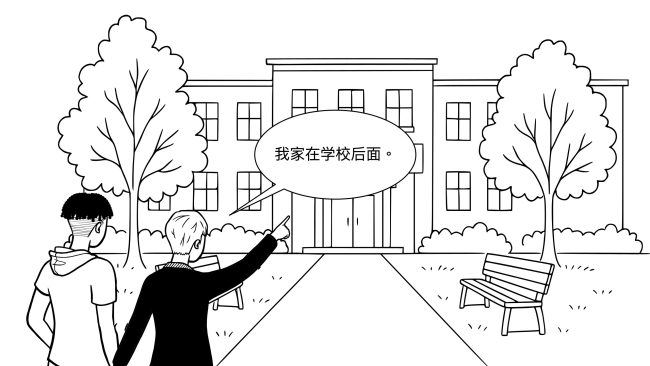
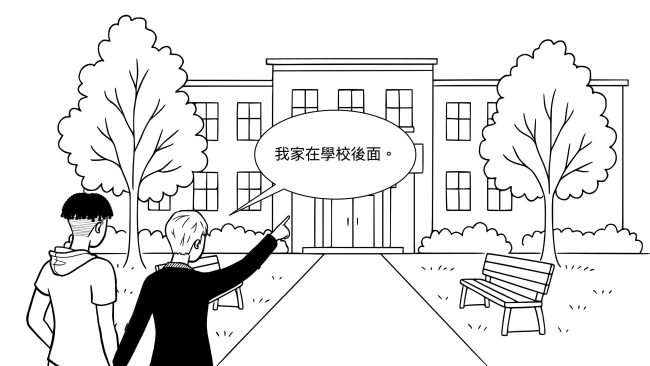
If the meaning of what the location word refers to is already clear from the context, the corresponding noun does not need to be mentioned additionally. In such cases, the location word can stand on its own and still be understood. For example, wǒ jiā zài hòumiàn 我家在后面/我家在後面 ‘my home is at the back’ and wǒ de péngyou zhàn zài wàibiān 我的朋友站在外边/我的朋友站在外邊 ‘my friend is standing outside’ are both grammatically correct.
Used in an existential sentence
Location words can be used in existential sentences. The attributive particle de 的 can be inserted between a noun and a location word, but this is not obligatory.
If the meaning of what the location word refers to is already clear from the context, the corresponding noun does not need to be mentioned additionally. In such cases, the location word can stand on its own and still be understood. For example, běibiān yǒu yì jiā Zhōngguó fànguǎn 北边有一家中国饭馆/北邊有一家中國飯館 ‘there is a Chinese restaurant up north’.
Used in an attributive structure
A location word can be used as an attributive to modify nouns.
If a location word is used in an attributive, the de 的 between a preceding noun and the location word can usually be omitted.
About expressions indicating direction or location, here are some important points to keep in mind:
1. Use of lǐ 里/裡, lǐbiān 里边/裡邊, and lǐmiàn 里面/裡面
Although the location words lǐ 里/裡, lǐbiān 里边/裡邊, and lǐmiàn 里面/裡面 can be translated as “inside” or “in,” they cannot be used after nouns referring to a nation or a city. It is wrong to say:
but
2. Use of shàng 上, shàngbiān 上边/上邊, and shàngmiàn 上面
Some monosyllabic direction words such as shàng 上, xià 下, lǐ 里/裡 and wài 外 can be placed directly after a noun. For example,zhuōzi shàngbiān 桌子上边/桌子上邊 ‘on the table’ can be reduced to 桌子上 and jiàoshì lǐmiàn 教室里面/教室裡面 ‘in the classroom’ to jiàoshì lǐ 教室里/教室裡, without changing the meaning.
However, it is important to note that shàng 上 and shàngbiān 上边/上邊, and also shàngmiàn 上面 can sometimes express different meanings, and the correct interpretation depends on the context.
When shàngbiān 上边/上邊 or shàngmiàn 上面 is placed after a noun, it refers to a concrete spatial location. In contrast, when shàng 上 appears after a noun, it may have a more abstract meaning, referring to the things included within the semantic scope of the noun. The following are some typical examples: