

 en
en cs
cs da
da de
de it
it pl
plLe 了 is a modal particle, which is always positioned at the end of a sentence. It conveys the meaning that something has changed from one state into another state or that a new situation has emerged. It is also referred to as le 了2 to distinguish it from the aspectual particle le 了1.
Structure
Basic form
The modal particle le 了 occurs at the end of a sentence with verbs or adjectives serving as predicates.
It can also be used with other predicates; for example, nouns or noun phrases expressing dates, seasons, person’s ages, etc.
Note that the modal particle le 了2 sometimes co-occurs with the aspectual particle le 了1 when there is only a simple object without modifiers. Without le 了2 at the end, the sentence could be perceived as incomplete.
Speakers often prefer using a single le 了 for simplicity, unless they need to emphasize the object or the finality of the action. Using only one le 了 conveys both the completion of the action and the emergence of a new situation.
Negation
To express that something has changed and no longer happens, bù 不 ‘not’ is placed before the verb or the adjective, and the modal particle le 了2 occurs at the end of the sentence. This structure indicates that a previous state or action has changed, and it does not occur anymore.
To indicate that a previous state is no longer the same as before, méi 没/沒 ‘not’ and méiyǒu 没有/沒有 ‘not’ can be placed before a noun phrase, and the modal particle le 了2 occurs at the end of the sentence. This structure emphasises that something used to exist or be available, but now it is gone or no longer the case.
When méi 没/沒 ‘not’ or méiyǒu 没有/沒有 ‘not’ is used in sentences with time-measure complements and the modal particle le 了2 at the end, the sentence emphasises that an action has not been performed for a specific period of time. This structure is commonly used to express how long something has been absent or not done and often implies that the speaker is thinking about the situation or considering a change.
Questions
There are two common ways to form a question with the modal particle le 了 to ask whether a change of state has occurred or a new situation has emerged:
- adding méi yǒu 没有/沒有 at the end of the sentence after le 了;
- adding the question particle ma 吗/嗎 at the end of the sentence after le 了.
With adverbs
The adverbs yǐjīng 已经/已經 and dōu 都 often occur with le 了2 to form a pattern dōu 都 or yǐjīng 已经/已經…… le 了 expressing that something has ‘already’ changed. The combination with the adverb dōu 都 conveys a more emphatic meaning than with the adverb yǐjīng 已经/已經.
The adverb tài 太 ‘too, very’ is often used with the modal particle le 了 to form a pattern tài 太…… le 了 in order to express that something is excessive. It can be used for both complaints and praise.
Note that the modal particle le 了 cannot be used in sentences with the adverbs cái 才 ‘a moment ago, just’ or gāng 刚/剛 ‘only a short while ago, just’.
Functions
1. Le 了2 expressing change of state
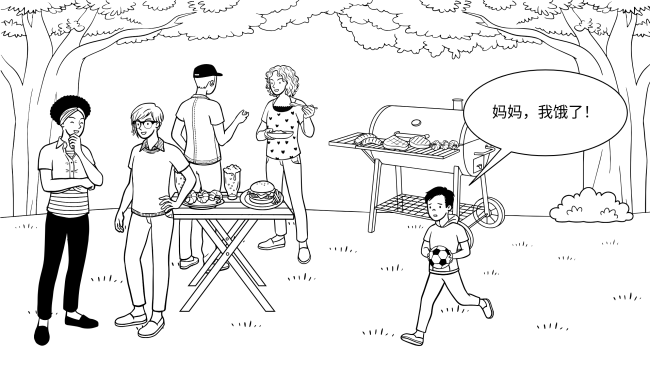
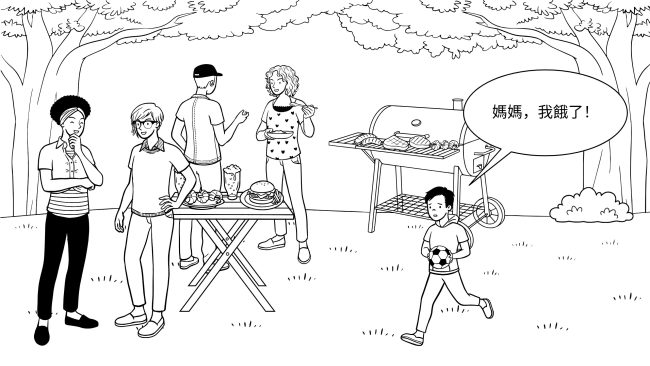
The modal particle le 了2 indicates a change of state as perceived by the speaker, such as the beginning of an action or the emergence of a new situation, to attract the listener’s attention. This change can have taken place just a moment ago, at some earlier point in the past or is just about to happen.
When the change of state occurred in the past, the speaker uses the modal particle le 了2 to draw attention to the new situation without specifying when it happened. The new state can be the result of an action that changed the previous state, as well as the speaker’s sudden awareness of something.
2. Le 了2 expressing action that began in the past and continues or has relevance to the present
The modal particle le 了2 can be used in sentences with the aspectual particle le 了1 to emphasize the completion of the action or the emergence of a new situation.
If there is a time-measure complement and a verb indicating duration, the presence of the modal particle le 了2 indicates that a certain portion of the action is complete but that the action is still continuing.
If the verb does not indicate duration, le 了2 emphasizes the relevance of the action to the present or serves as confirmation that an action has been completed.
Also check Aspectual particle le 了1
3. Le 了2 expressing probability and likelihood in an imminent or near future
When the change of state is just about to happen, the new state can be considered an imminent or planned probability or likelihood. This is expressed by using the pattern jiùyào 就要 ‘about to’ / kuài 快 ‘quickly’ / kuàiyào 快要 ‘soon’…… le 了. The modal particle le 了2 confirms the sense of change of circumstances.
4. Le 了2 expressing the ending of an action or state
When the change of state is the ending of a previous action or state, the negation bù 不 ‘not’ precedes the verb, and the modal particle le 了2 is at the end of the sentence. This structure means that the action no longer continues or that the state will no longer exist as it did before.
Other structures with le 了2, such as the imperatives bú yào 不要…… le 了 and bié 别/別…… le 了, can indicate that the speaker wants to bring the situation to a close and does not want it to continue or occur again.
The change of state can also be the ending of an action that has lasted an unusually long time or ended shortly before being mentioned. In these sentences, the time when the action occurs or a time-measure complement indicating the state or duration of the action is followed by the negation méi 没/沒 and the modal particle le 了2 at the end of the sentence.