

 en
en cs
cs da
da de
de it
it pl
plLe 了 is an aspectual particle, which always follows the verb in a sentence, and it is mainly used to mark the occurrence or the completion of an action in the past, in a specified time, but also in the present or future. It is also referred to as le 了1 to distinguish it from the modal particle le 了2.
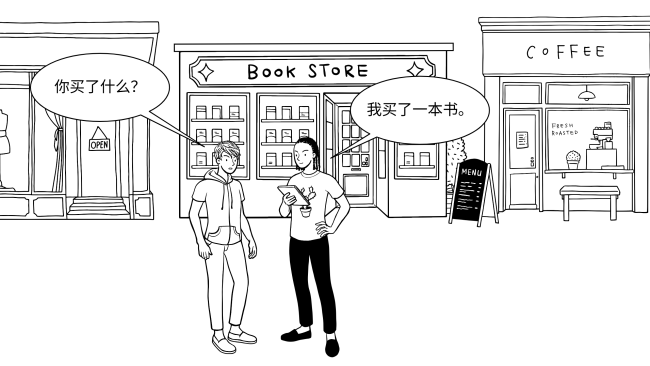
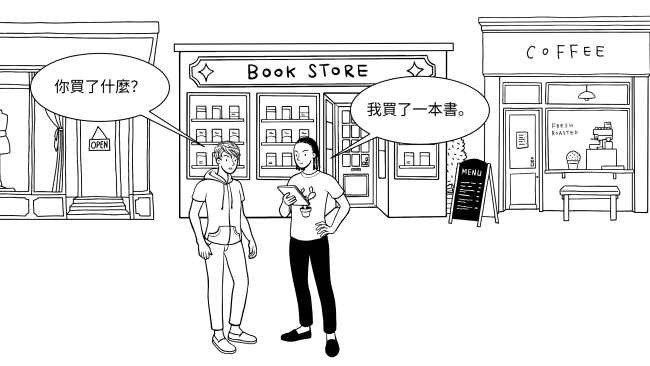
Structure
Basic form
Le 了 always follows the verb in a sentence. It only pairs with verbs describing actions that can be completed, which are generally followed by complements, verbal measure words or objects preceded by a modifier, such as yí ge 一个/一個 ‘one’, zhè xiē 这些/這些 ‘these’, wǒ de 我的 ‘my’, etc.
In general, if the object is not preceded by a modifier, the sentence could be perceived as incomplete. In this case, the sentence should be modified as follows:
- Adding the modal particle le 了2 at the end of sentence. However, in short sentences with an object without modifiers, it is generally preferable to use only one le 了 to convey the completion of the action and the new situation;
- Continuing the sentence by repeating the same action or adding more objects;
- Continuing the sentence with another clause introduced by jiù 就 ‘immediately’ or cái 才 ‘only then’.
Note that in sentences with separable verbs, le 了 is placed directly after the verb and before the object. Separable verbs are a specific group of disyllabic verbs where the two elements can be split because the first element is typically a verb indicating an action, while the second one is often a noun representing the object of that action. Examples of such verbs include chī fàn 吃饭/吃飯 ‘to eat’, jiàn miàn 见面/見面 ‘to meet’ or shuì jiào 睡觉/睡覺 ‘to sleep’.
Negation
In sentences negating the completion of an action, méi 没/沒 is placed before the main verb to indicate that the action has not been completed. For added emphasis, méiyǒu 没有/沒有 can be used instead of méi 没/沒. Since le 了 marks the completion of an action, it is not used in negative sentences.
Modifiers composed of numerals and measure words, such as yí ge 一个 ‘one’, are usually not used in short negative sentences. They are included only if strictly required from the context, as in the following example:
Questions
There are five common ways to form a question with the aspectual particle le 了 to ask if someone has completed an action:
- adding méi yǒu 没有/沒有 at the end of the sentence with le 了;
- reduplicating the verb and adding méi 没/沒 between them;
- adding the question particle ma 吗/嗎 at the end of the sentence with le 了;
- adding shì bu shì 是不是 in front of the verb followed by le 了;
- adding yǒu méi yǒu 有没有/有沒有 before the verb.
Note that only the 2nd and the 5th ways do not include le 了 in the sentence.
The 1st and the 2nd ways are often used in sentences with objects preceded by a modifier such as zhè xiē 这些/這些 ‘these’ or wǒ de 我的 ‘my’, etc.
Modifiers composed of numerals and measure words, such as yí ge 一个 ‘one’, are usually not used in interrogative sentences. They are included only if strictly required from the context, as in the following example:
In this case, when the context requires the use of modifiers composed of numerals and measure words, the interrogative sentence could be realized with the 3rd or 4th ways mentioned above.
The 5th way is usually used to form an interrogative sentence when the focus is on whether the action has been completed, without emphasising specific details such as quantity or modifiers.
Interrogative sentences created by adding shì bu shì 是不是 in front of the verb can be answered affirmatively by using shì(de) 是(的) or negatively by using bú shì 不是.
All the other types of questions mentioned above can be answered affirmatively by using the ‘verb + le 了’ phrase alone, or negatively by using the ‘méi(yǒu) 没(有)/沒(有) + verb’ phrase.
With adverbs
The adverbs, such as hái 还/還, are placed before the verb: in affirmative sentences the verb is followed by le 了; in negative sentences with méi(yǒu) 没(有)/沒(有), le 了 is not included. The adverb hái 还/還 means ‘in addition’ in affirmative sentences and ‘not yet’ in negative sentences.
The adverb yǐjīng 已经/已經 ‘already’ often occurs before a completed action to emphasise that the action has already been concluded.
The adverb yòu 又 ‘again’ often occurs in sentences with le 了 to indicate that an action has been concluded or has occurred again.
With complements
If the action is completed, le 了 is placed after the main verb and before directional complements providing additional information about the direction and movement of the action, time-measure complements indicating the duration of the action, or quantitative complements indicating the number of times the action takes place.
For further information about the position of an object in sentences with quantitative complements and time-measure complements, also check Quantitative complement and Time-measure complement.
If the action is completed, le 了 is placed after the result complement indicating the result or the completion of the action.
With verb reduplication
Verb reduplication can express a quick and brief action or soften the tone. There are three patterns for verb reduplication:
- AA Pattern used for monosyllabic verbs, where the verb is repeated twice, like kànkan 看看 ‘to have a look’;
- AAB Pattern used for separable verbs, where only the verb is repeated, not the object, like sànsànbù 散散步 ‘to have a stroll’;
- ABAB Pattern used for disyllabic verbs, where the entire verb is repeated, like xiūxi xiūxi 休息休息 ‘to take a break’.
To express completion, le 了 is placed after the first verb in AA and AAB patterns, and it is not used in ABAB pattern.
In serial verb constructions
Serial verb constructions typically consist of a sentence with two or more verbs or verbal constructions that share the same subject. These constructions can express reason, purpose, sequential actions or manner of performing an action. If both actions are completed, le 了 is placed after the second verb.
Functions
1. Le 了 expressing completion or occurrence of an action
Le 了 often occurs in sentences that indicate the occurrence or completion of an action in the past, usually in a specified time, but also in the present or future.
Le 了 cannot be used for regular or habitual activities.
Le 了 can only be used for actions that can be completed. It is generally not used with verbs describing mental states like zhīdào 知道 ‘to know’ or relational states like shì 是 ‘to be’, with causative verbs that induce action in someone or something else like ràng 让/讓 ‘to let’, or with modal verbs expressing possibility or ability like néng 能 ‘to can, be able to’, intention, obligation or willingness like yào 要 ‘to want, need to’, rather than completed actions. However, there are some exceptions.
Verbs describing a state, such as rènshi 认识/認識 ‘to know’, xiāngxìn 相信 ‘to believe’, liǎojiě 了解 ‘to understand’, shúxī 熟悉 ‘to be familiar’, hūshì 忽视/忽視 ‘to ignore’ or wùjiě 误解/誤解 ‘to misunderstand’, do not have a point of completion, therefore they cannot be followed by le 了. The only possibility of using le 了 with these verbs is if they are further described by an element which frames the action as it is completed. This further description can be an object with a modifier composed of a numeral and a measure word.
Some verbs such as xiāngxìn 相信 ‘to believe’, hūshì 忽视/忽視 ‘to ignore’ or wùjiě 误解/誤解 ‘to misunderstand’, can be followed by le 了even if they have a simple object without modifiers after it.
Some verbs describing lasting emotions, such as ài 爱/愛 ‘to love’, can be followed by le 了 only if they are followed by a complement, which changes the meaning, for example into àishang 爱上/愛上 ‘to fall in love’.
Sometimes, le 了 can be used to emphasize the occurrence of an event, as follows.
Also check Comparison: aspectual particles guo 过 and le 了1
2. Le 了 expressing the order of actions in sequence
Le 了 can be used to indicate that two actions occur in sequence. It indicates that a second action occurs after a previous action is completed. However, the actions are not necessarily realized in the past; they may also occur in the future. In general, the second clause is introduced by the adverbs jiù 就 ‘immediately’ or cái 才 ‘only then’.
In sentences with the adverb jiù 就, if the action occurred in the past, the second verb or the object of the second verb is followed by the modal particle le 了.