

 en
en cs
cs da
da de
de it
it pl
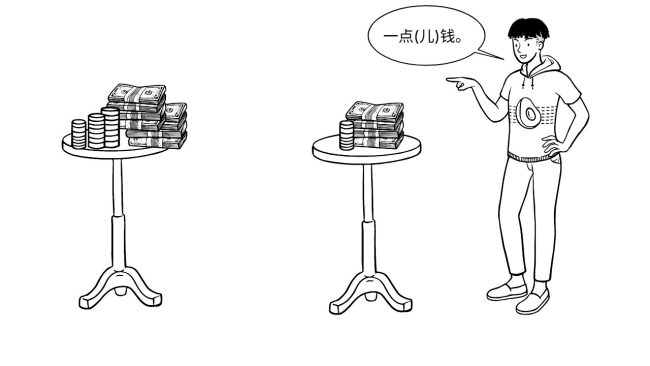
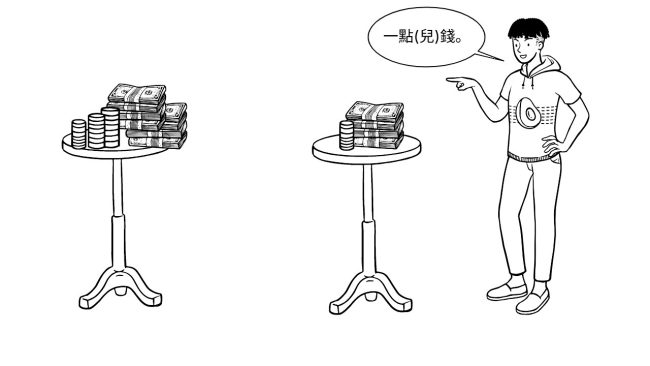
plYìdiǎn(r) 一点(儿)/一點(兒) is a modifier that helps specify small amounts or slight degrees. It can be used with both nouns and adjectives.
Note, that the er 儿/兒 after yìdiǎn(r) 一点(儿)/一點(兒) is optional and often omitted in colloquial speech. In spoken language 一 can also be omitted for brevity.
Additionally, diǎn 点/點 can be reduplicated as yìdiǎndiǎn 一点点/一點點 to express ‘a little bit’。
Structure
Basic form
With a noun
Yìdiǎn(r) 一点(儿)/一點(兒) comes before the noun it describes.
With an adjective
Yìdiǎn(r) 一点(儿)/一點(兒) comes after the adjective it describes.
Negation
In a sentence with a negation the adverb yìdiǎn(r) 一点(儿)/一點(兒) is usually omitted, even when responding to a question that contains yìdiǎn(r) 一点(儿)/一點(兒).
The following could be an answer to a question like nǐ xiǎng hē diǎn(r) shuǐ ma? 你想喝点(儿)水吗?/你想喝點(兒)水嗎? ’would you like some water?’
However, yìdiǎn(r) 一点(儿)/一點(兒) can be used in a more complex structure to indicate ‘not at all‘ when combined with yě 也 or dōu 都.
Questions
There are two ways to ask a yes-no question with yìdiǎn(r) 一点(儿)/一點(兒).
One way is to add the question particle ma 吗/嗎 at the end of the sentence.
Another way to form a yes-no question is by combining the affirmative and negative forms of the verb.
If the sentence contains a modal verb, the modal verb is reduplicated.
With adverbs
Adverbs, such as dōu 都 ‘both, all’ and yě 也 ‘also’ are placed before the verb. If a sentence contains a modal verb, the adverb appears before the modal verb.
With prepositional phrases
A prepositional phrase should be placed before the main verb.
Functions
1. Yìdiǎn(r) 一点(儿)/一點(兒) expressing ‘a little of something‘
Before a noun yìdiǎn(r) 一点(儿)/一點(兒) is used to express an indefinite, small quantity of something. The noun yìdiǎn(r) 一点(儿)/一點(兒) modifies, is often a mass noun that represents something impossible or difficult to count.
Sometimes when the context makes it clear what is being referred to, the noun is left out and yìdiǎn(r) 一点(儿)/一點(兒) functions as the object in the sentence. This mainly happens in spoken Chinese and often in answer to a question.
2. Yìdiǎn(r) 一点(儿)/一點(兒) expressing ‘a little bit more‘
After an adjective yìdiǎn(r) 一点(儿)/一點(兒) indicates a slight degree or extent. It is commonly used to make comparisons indicating a vague difference.
Yìdiǎn(r) 一点(儿)/一點(兒) can also be used to compare two things explicitly.
Note: it is easy to confuse adjective + yìdiǎn(r) 一点(儿)/一點(兒) with yǒu yìdiǎn(r) 有一点(儿)/有一點(兒) + adjective because the forms are similar. See the comparison: yìdiǎn(r) 一点(儿)/一點(兒) vs. yǒu yìdiǎn(r) 有一点(儿)/有一點(兒).
3. Yìdiǎn(r) 一点(儿)/一點(兒) in a request or polite question
Yìdiǎn(r) 一点(儿)/一點(兒) is commonly used to soften the tone of a request, order or instruction, making it less direct and thereby more polite. By adding yìdiǎn(r) 一点(儿)/一點(兒), you can imply a small amount or degree, which can make your request seem less demanding. It can be used with both adjectives and nouns to make requests.
When translating into English yìdiǎn(r) 一点(儿)/一點(兒) is sometimes omitted because its inclusion would be redundant or awkward.