

 en
en cs
cs da
da de
de it
it pl
plIn some comparative constructions in Chinese, the verb yǒu 有 is used not in its usual sense of ‘to have’ or ‘to exist’, but as part of a comparison.
In affirmative sentences, yǒu 有 is used as a comparative marker, meaning something like ‘matches in degree or quality’. It shows that A is equal to or perhaps stronger than B in the feature compared. It often carries a rhetorical, sceptical, or confrontational tone and appears mostly in rhetorical or subjective questions.
In comparative sentences the affirmative form yǒu 有 is not used, as often as the negative form with méi yǒu 没有/沒有. Yǒu 有 is typical of spoken and informal contexts and mainly used in questions, often rhetorical in nature, or in subjective comparisons that reflect personal impressions or judgments.
Also check Comparisons with méi yǒu 没有/沒有.
Structure
Basic form
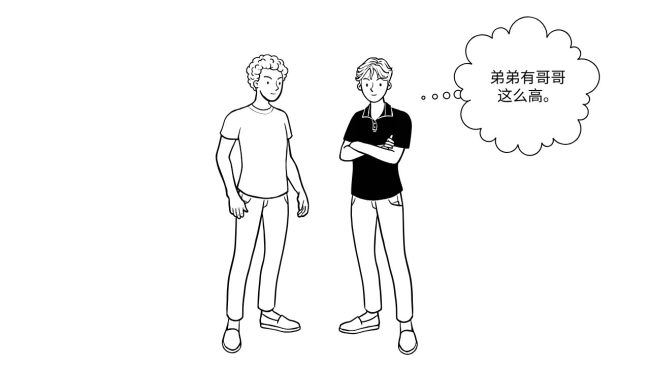
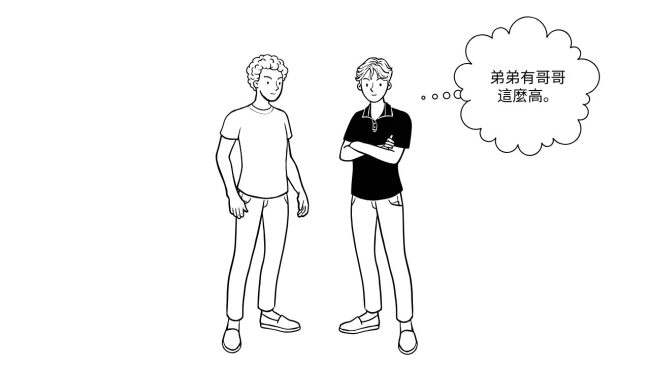
The verb yǒu 有indicates in what respect two people or things share a similar degree of a particular feature. In this usage, yǒu 有 introduces the standard of comparison with the second item or person (B) serving as the reference point. The two items or people can be equal or the first might be stronger in the feature compared.
In this type of comparison zhème 这么/這麼 ‘so; like this’ or nàme 那么/那麼 ‘so; like that’ are often used to indicate the extent to which the second item possesses a feature and forming the standard against which the first item is compared.
Question
Comparisons with yǒu 有 are mainly used in questions, often rhetorical ones.
There are two ways to form a yes-no question. One way is simply to place the question particle ma 吗/嗎 at the end of the sentence.
Note, when you ask a yes-no question, you already know how much B possess of the feature being compared.
Another way to form a yes-no question is by combining the affirmative and negative forms of yǒu 有.
With abverbs
Degree adverbs such as hěn 很 ‘very’, fēicháng 非常 ‘very’ or tài 太 ‘very’ cannot be used in comparisons with yǒu 有. Instead, the comparison is often emphasised with one of the demonstrative pronouns, zhème 这么/這麼 ‘so; like this’ or nàme 那么/那麼 ‘so; like that’, functioning as a degree adverbial – see structures above.
Adverbs such dōu 都 ‘all; both’ and yě 也 ‘also’ are placed before yǒu 有.
Functions
Yǒu 有 expressing equal comparison
It can express an equal-degree comparison. The second item or person being compared is used as standard to describe whether the first item or person has reached that level.
The two items or persons compared can be equal or the first might be stronger in the feature compared. In this context yǒu 有 does not mean ‘to have’ or to ‘exist’ but functions as a comparative marker for equal degree.
When yǒu 有 is used in comparative sentences, it is rarely completely neutral. It is often used in rhetorical questions or situations where the speaker wants to challenge a claim or emphasise a contrast.
Zhème 这么/這麼 ‘so; like this’ or nàme 那么/那麼 ‘so; like that’ are typically used are used to emphasise the extent to which the second item possesses a feature.
Note, the comparative pattern with yǒu 有 is far less common than the one with méi yǒu 没有/沒有.