

 en
en cs
cs da
da de
de it
it pl
plCóng 从/從 ‘from; since’ is a preposition used to indicate the place or point in time something begins.
Structure
Basic form
Cóng 从/從 and the place or point in time must precede the verb.
Negation
The negation adverb precedes the starting point in place or time and the verb follows. Whether you use bú (shì), 不(是) or méi 没/沒 to negate, depends on the type of sentence, not on cóng 从/從.
Questions
To form a yes-no question, simply put the question particle ma 吗/嗎 at the end of the sentence.
To ask about ‘when’ or ‘where’, place the question word after cóng 从/從.
With adverbs
Adverbs, such as dōu 都 ‘both, all’ and yě 也 ‘also’, are usually placed before cóng 从/從.
With prepositional phrases
A prepositional phrase with cóng 从/從 is often used together with dào 到 ‘to’ to indicate the endpoint of the subject’s movement or the conclusion of an event in terms of place or time.
Functions
Cóng 从/從 is a multifunctional preposition used in various contexts.
1. Cóng 从/從 expressing the starting point of an action or movement
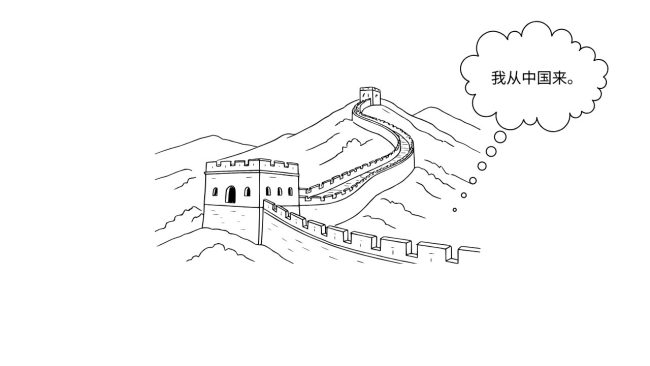
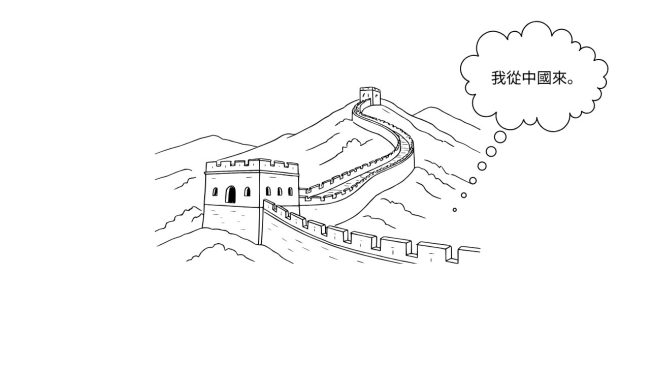
When indicating that someone comes or starts from a location, the location is inserted after cóng 从/從.
When asking about ‘where’ cóng 从/從 remains in the sentence.
The place of origin might also be ‘from somebody’ or ‘from something’.
Cóng 从/從 typically requires a location word to clearly indicate the starting point. When referencing a person as the origin, it’s important to include a location word, such as zhèr 这儿/這兒 or nàr 那儿/那兒 to avoid ambiguity and ensure grammatical correctness.
When expressing a movement like ‘up’, down’, ‘in’ or ‘out’ from somewhere, the verb can be followed by a directional complement, such as chūlái 出来/出來 ‘to come out’, jìnlái 进去/進去 ‘to go in’, shànglái 上来/上來 ‘to come up’ or xiàqù 下去 ‘to go down’.
Also check: Simple directional complement and Compound directional complement
To express both the starting and the endpoint of a movement or an action cóng 从/從 ‘from’ can be used together with dào 到 ‘to’.
2. Cóng 从/從 expressing a starting point in time
When used with time expressions, cóng 从/從 indicates when something begins. In this context, it can sometimes be translated as ‘since‘.
To describe the duration of various activities, events, states and experiences cóng 从/從 ‘from’ can be used together with dào 到 ‘to’. The construction indicates a clear time span from the start to the end point, providing a precise way to discuss the duration of different actions and situations. The time can be a specific point in time or the point at which an action or event takes place, for example. ‘when I graduated’ or ‘when the match begins’.
The subject can be placed either before or after the cóng … dào 从/從 … 到 structure.