

cóng
adverb

HSK1 TBCL1

Cóng 从/從 ‘from; since’ is a preposition used to indicate the place or point in time something begins.
adv.cong

Structure

Basic form

Cóng 从/從 and the place or point in time must precede the verb.

Subject
cóng
cóng
place
中国
中國
Zhōngguó
verb
来。
來。
lái.
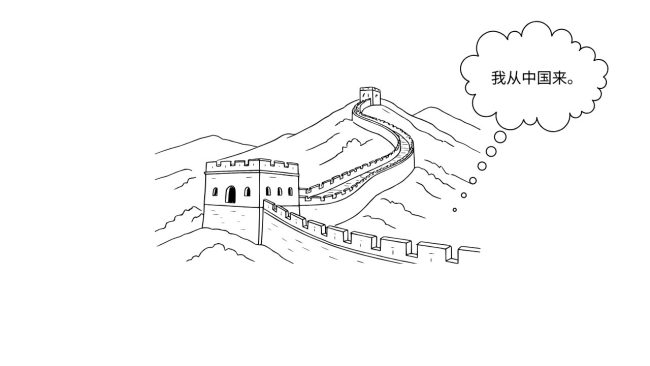
I come from China.
Subject
考试
考試
Kǎoshi
cóng
cóng
time
下午三点
下午三點
xiàwǔ sān diǎn
verb
开始。
開始。
kāishǐ.
The exam starts at 3 p.m.

Negation

The negation adverb precedes the starting point in place or time and the verb follows. Whether you use bú (shì), 不(是) or méi 没/沒 to negate, depends on the type of sentence, not on cóng 从/從.

Subject
negation
cóng
cóng
place
中国
中國
Zhōngguó
verb
来。
來。
lái.
I do not come from China.
Subject
他们
negation
méi
cóng
cóng
place
飞机上
飛機上
fēijī shàng
verb
下来。
下來。
xiàlái.
I did not get off the plane.

Question

To form a yes-no question, simply put the question particle ma 吗/嗎 at the end of the sentence.

Subject
cóng
cóng
place/time
中国
中國
Zhōngguó
verb
lái
ma
吗?
嗎?
ma?
Do you come from China?


To ask about ‘when’ or ‘where’, place the question word after cóng 从/從.

Subject
cóng
cóng
place/time
哪儿
哪儿
nǎer
verb
来?
來?
lái?
Where do you come from?

With adverbs

Adverbs, such as dōu ‘both, all’ and ‘also’, are usually placed before cóng 从/從.

Subject
adverb
cóng
cóng
place/time
中国
中國
Zhōngguó
verb
来。
來。
lái.
I also come from China.

With prepositional phrase

A prepositional phrase with cóng 从/從 is often used together with dào ‘to’ to indicate the endpoint of the subject’s movement or the conclusion of an event in terms of place or time.

Subject
cóng
time/place 1
八点
八點
bā diǎn
dào
time/place 2
十点
十點
shí diǎn
verb
yǒu
object
中文课。
中文課。
Zhōngwénkè.
I have Chinese classes from eight to ten.

Functions

Cóng 从/從 is a multifunctional preposition used in various contexts.

1. Cóng /從 expressing the starting point of an action or movement

When indicating that someone comes or starts from a location, the location is inserted after cóng 从/從.

我从家里走路去学校。
我從家裡走路去學校。
Wǒ cóng jiā li zǒu lù qù xuéxiào.
I walk from home to school.
你从这儿走,十分钟就到超市了。
你從這兒走,十分鐘就到超市了。
Nǐ cóng zhèr zǒu, shí fēn zhōng jiù dào chāoshì le.
You can walk from here and you'll be at the supermarket in ten minutes.

When asking about ‘where’ cóng 从/從 remains in the sentence.

A: 你从哪儿来?
你從哪兒來?
Nǐ cóng nǎr lái?
Where do you come from?
B: 我从北京来。
我從北京來。
Wǒ cóng Běijīng lái.
I come from Beijing.

The place of origin might also be ‘from somebody’ or ‘from something’.

我从书包里拿出一本书。
我從書包里拿出一本書。
Wǒ cóng shūbāo lǐ náchū yì běn shū.
I took a book out of the schoolbag.

Cóng 从/從 typically requires a location word to clearly indicate the starting point. When referencing a person as the origin, it’s important to include a location word, such as zhèr 这儿/這兒 or nàr 那儿/那兒 to avoid ambiguity and ensure grammatical correctness.

我从一个朋友那里借了钱。
我從一個朋友那裡借了錢。
Wǒ cóng yí ge péngyou nàli jiè le qián.
I borrowed money from a friend.

When expressing a movement like ‘up’, down’, ‘in’ or ‘out’ from somewhere, the verb can be followed by a directional complement, such as chūlái 出来/出來 ‘to come out’, jìnlái 进去/進去 ‘to go in’, shànglái 上来/上來 ‘to come up’ or xiàqù 下去 ‘to go down’.

老师从教室走出来。
老師從教室走出來。
Lǎoshī cóng jiàoshì zǒuchūlai.
The teacher comes walking out of the classroom.
他们从楼上跑下来。
他們從樓上跑下來。
Tāmen cóng lóu shang pǎoxiàlai.
They come running down from upstairs.

Also check: Directional complements

To express both the starting and the endpoint of a movement or an action cóng 从/從 ‘from’ can be used together with dào ‘to’.

从我家到大学很远。
從我家到大學很遠。
Cóng wǒ jiā dào dàxué hěn yuǎn.
It's a long way from my home to the university.
我每天从家到办公室都走路。
我每天從家到辦公室都走路。
Wǒ měi tiān cóng jiā dào bàngōngshì dōu zǒu lù.
I walk from my home to the office every day.
从图书馆到餐厅怎么走?
從圖書館到餐廳怎麼走?
Cóng túshūguǎn dào cāntīng zěnme zǒu?
How do I get from the library to the restaurant?

2. Cóng /從 expressing a starting point in time

When used with time expressions, cóng 从/從 indicates when something begins. In this context, it can sometimes be translated as ‘since‘.

我从去年开始学中文。
我從去年開始學中文。
Wǒ cóng qùnián kāishǐ xué Zhōngwén.
I have been learning Chinese since last year.

To describe the duration of various activities, events, states and experiences cóng 从/從 ‘from’ can be used together with dào ‘to’. The construction indicates a clear time span from the start to the end point, providing a precise way to discuss the duration of different actions and situations. The time can be a specific point in time or the point at which an action or event takes place, for example. ‘when I graduated’ or ‘when the match begins’.

从星期二到星期五一直下雨。
從星期二到星期五一直下雨。
Cóng xīngqī'èr dào xīngqīwǔ yìzhí xià yǔ.
It rained from Tuesday to Friday.
从2024年到2025年,我都在北京学习。
從2024年到2025年,我都在北京學習。
Cóng 2024 nián dào 2025 nián, wǒ dōu zài Běijīng xuéxí.
From 2024 to 2025, I studied in Beijing.
我从小到现在都没吃过鱼。
我從小到現在都沒吃過魚。
Wǒ cóng xiǎo dào xiànzài dōu méi chī guo yú.
I haven't eaten fish since I was a kid.
学生从上课到下课都在睡觉。
學生從上課到下課都在睡覺。
Xuésheng cóng shàng kè dào xià kè dōu zài shuì jiào.
The students slept from the beginning to the end of class.

The subject can be placed either before or after the cóng dào 从/從 structure.

学生从星期二到星期五有课。
學生從星期二到星期五有課。
Xuésheng cóng xīngqī'èr dào xīngqīwǔ yǒu kè.
The students have classes from Tuesday to Friday.
学生从星期二到星期五有课。
從星期二到星期五學生有課。
Cóng xīngqī'èr dào xīngqīwǔ xuésheng yǒu kè.
The students have classes from Tuesday to Friday.

3. Cóng/從 indicating through, or past a place

这路公共汽车从图书馆门口经过。
這路公共汽車從圖書館門口經過。
Zhè lù gōnggòng qìchē cóng túshūguǎn ménkǒu jīngguò.
This bus passes in front of the library.
我去办公室的时候,从公园门口经过。
我去辦公室的時候,從公園門口經過。
Wǒ qù bàngōngshì de shíhou, cóng gōngyuán ménkǒu jīngguò.
I pass by the park entrance on my way to the office.
你从这条路走比较快。
你從這條路走比較快。
Nǐ cóng zhè tiáo lù zǒu bǐjiào kuài.
It's faster if you take this road.

Also check 离

Also check 从 v.s. 离