

 en
en cs
cs da
da de
de it
it pl
plYǒu (yì) diǎn(r) 有 (一)点(儿)/有 (一)點(兒) ‘a little; a bit’ indicates a small quantity or slight degree that is often unexpected or not ideal. When it is followed by an adjective, it usually expresses mildly negative feelings, such as dissatisfaction, discomfort, or undesired intensity. It is commonly used in spoken Chinese, and yī 一 ‘one’ and r 儿 are often omitted in a colloquial context. So, there are quite a few variations of the same expression: 有点/有點、有一点/有一點、有点儿/有點兒、有一点儿/有一點兒.
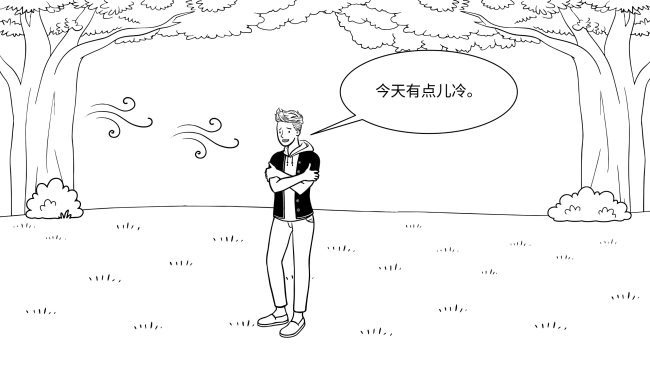
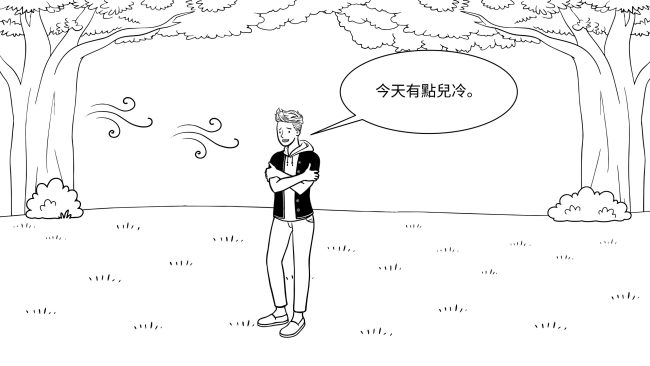
Structure
Basic form
Yǒuyìdiǎn(r) 有 一点儿/有一點兒 is placed before an adjective or a verb. The verbs it modifies are usually those that express emotions and feelings, such as xiǎng 想 ‘to want; to miss’, hàipà 害怕 ‘to be afraid’, tǎoyàn 讨厌/討厭 ‘to dislike’, hèn 恨 ‘to hate’, fán 烦/煩 ‘to be annoyed’, shēng qì 生气/生氣 ‘to be angry’.
Because yǒuyìdiǎnr 有一点儿/有一點兒 often expresses something undesired or unexpected when it is followed by an adjective, it is not normally used with positive adjectives, unless the situation clearly makes the positive meaning sound ironic or unexpected. For example, Háizi yǒudiǎnr kě’ài. 孩子有点儿可爱。/ 孩子有點兒可愛。’The kid is a little cute.’ This sentence is not straightforward praise. Depending on the context and the tone, it often sounds unexpected, slightly reluctant, or even a bit sarcastic.
Negation
Yǒuyìdiǎnr 有 一点儿/有 一點兒 is generally not used in negative sentences. Instead, expressions such as bú tài 不太 ‘not so’ or bù zěnme 不怎么/不怎麼 ‘not that’ are preferred.
However, it is possible to use yǒuyìdiǎnr 有一点儿/有一點兒 before bù 不. In this case, the speaker is saying “a bit not.”
Question
Questions are formed by adding the question particle ma 吗/嗎 at the end of the sentence. The A-not-A pattern is not normally not used with yǒu (yì) diǎn(r) 有(一)点(儿)/有(一)點(兒); speakers prefer simple ma 吗/嗎 questions or other mild patterns such as bú tài 不太 + adj.
Another way to form a question is to use shì bú shì 是不是 before yǒu(yì)diǎn(r) 有 (一)点(儿)/有 (一)點(兒).
With adverbs
When other adverbs appear in a sentence, they are usually placed before yǒuyìdiǎnr 有一点儿/有一點兒. This includes adverbs of scope (yě 也 ‘also’, dōu 都 ‘both; all’, yìqǐ 一起 ‘together’), time or frequency (chángcháng 常常 ‘often’, yǐjīng 已经/已經 ‘already’, yǒushíhòu 有时候/有時候 ‘sometimes’), and attitude (zhēnde 真的 ‘really’, běnlái 本来/本來 ‘originally’).
Note: Although yǒuyìdiǎnr 有一点儿/有一點兒 + Adjective/Verb and yǒuyìdiǎnr 有一点儿/有一點兒 + Noun seem to share a similar pattern, they represent different grammatical items. Compare the following two sentences.
Yǒuyìdiǎnr 有一点儿/有一點兒 in the first sentence functions as an adverb meaning ‘a little’. In the second, yǒu 有 is a verb meaning ‘to have’, and yìdiǎnr 一点儿/一點兒 functions as a quantifier phrase indicating a small quantity.
Functions
1. Yǒu yìdiǎnr 有一点儿/有一點兒 expressing a degree with a slightly negative connotation
Yǒuyìdiǎnr 有一点儿/有一點兒 is most commonly used to express a mild negative evaluation. It can soften a complaint or signal polite dissatisfaction.
Note: the adjectives co-occur with yǒuyìdiǎnr 有一点儿/有一點兒 usually indicate undesirable qualities or emotional states, such as lěng 冷 ‘cold’, lèi 累 ‘tired’, nán 难/難 ‘difficult’, guì 贵/貴 ‘expensive’, fán 烦/煩 ‘annoyed’, zāng 脏/髒 ‘dirty’, máng 忙 ‘busy’, shēngqì 生气/生氣 ‘angry’, bù shūfu 不舒服/不舒服 ‘uncomfortable’, dānxīn 担心/擔心 ‘worried’, and shīwàng 失望/失望 ‘disappointed’.
2. Yǒu yìdiǎnr 有一点儿/有一點兒 softening the tone
Compared with direct degree adverbs like hěn 很 ‘very’ or fēicháng 非常 ‘extremely’, using yǒuyìdiǎnr 有一点儿/有一點兒 before an adjective can make a comment less direct, more polite, or more tentative. When used before verbs or verb phrases, it can also soften a request or suggestion, often implying a gentle expectation rather than a strong demand. In this way, it may carry a subtle pragmatic meaning beyond simple degree.