

gěi
preposition

HSK2

Gěi/‘to/for’ is a preposition introducing a recipient (a noun or a pronoun) toward whom or for whom the action is performed or indicating that something is transferred from the subject to the recipient or introducing a beneficiary of an action. Together with a noun or pronoun it forms a prepositional phrase that is placed before a verb.
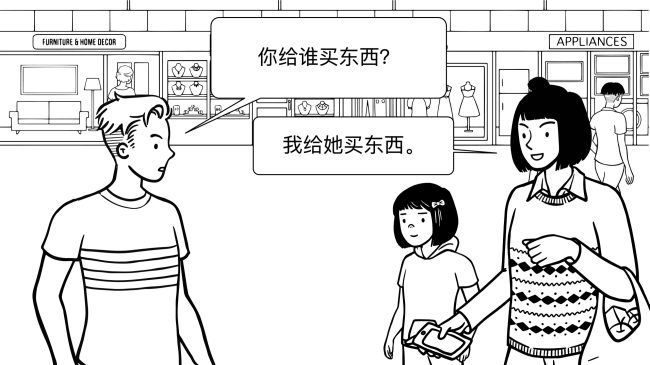
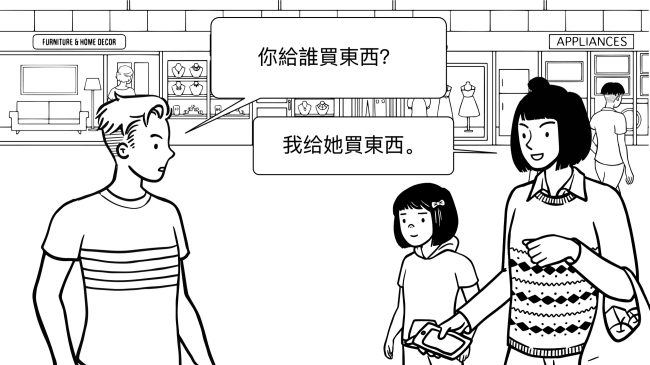
Structure

Basic form

The preposition gěi / together with a pronoun, noun, or noun phrase forms a prepositional phrase, that is usually placed before the verb.

subject
gěi
noun/pronoun
verb
mǎi
object
东西。
東西。
dōngxi.
I do shopping for her. / I buy something for her.

Negation

In negative sentences, adverbs of negation ‘not’ or méi /‘not’ usually appear before the prepositional phrase with gěi /.

subject
gěi
noun/pronoun
verb
mǎi
object
东西。
東西。
dōngxi.
I do not do shopping for her. /I don’t buy anything for her.

Question

Yes-no questions with question particle ma /are formed in the usual way by adding ma / at the end of the sentence.

subject
gěi
noun/pronoun
妈妈
媽媽
māmā
verb
xiě
object
xìn
ma?
Are you writing letter to mum?

Another type of yes-no questions is formed by combining affirmative and negative form of gěi /.

subject
gěi
gěi
noun/pronoun
verb
mǎi
object
东西?
東西?
dōngxi?
Do you do shopping for her?

If the sentence contains a modal verb, yes-no questions are formed by combining affirmative and negative form of the modal verb.

subject
modal verb
xiǎng
modal verb
xiǎng
gěi
noun/pronoun
verb
mǎi
object
东西?
東西?
dōngxi?
Would you like to do shopping for her?

With adverbs

Adverbs usually need to be placed before the prepositional phrase with gěi /.

subject
adverb
经常
經常
jīngcháng
gěi
noun/pronoun
我妈妈
我媽媽
wǒ māma
verb
object
电话。
電話。
diànhuà.
I often call my mom.
subject
adverb
yòu
gěi
noun/pronoun
大家
大家
dàjiā
verb
zuò
object
fàn
了。
了。
le.
He has cooked a meal for everybody again.

With modal verbs

Modal verbs, with or without negation, usually need to be placed before the prepositional phrase with gěi /.

subject
modal verb
可以
可以
kěyǐ
gěi
noun/pronoun
verb
mǎi
object
东西。
東西。
dōngxi.
I can do shopping for her.
subject
modal verb
néng
gěi
noun/pronoun
verb
mǎi
object
东西。
東西。
dōngxi.
I cannot do shopping for her.

Verbs that can take two objects, such as jiāo ‘to teach’, wèn /‘to ask’, jiāo ‘to hand over’, gàosu 告诉/告訴 ‘to tell’, cannot be preceded by prepositional phrases with gěi /. The verb bāngzhù 帮助/幫助 ‘to help’ also cannot be preceded by prepositional phrases with gěi /.

Functions

1. Gěi / is used to introduce the beneficiary of an action.

明年春天他们打算给女儿买一套房子。
明年春天他們打算給女兒買一棟房子。
Míngnián chūntiān tāmen dǎsuan gěi nǚ’ér mǎi yí tào fángzi.
Next spring they are going to buy a house for their daughter.
老师给大家准备了一些中国小吃。
老師給大家準備了一些中國小吃。
Lǎoshī gěi dàjiā zhǔnbèi le yìxiē Zhōngguó xiǎochī.
The teacher prepared some Chinese snacks for everybody.

2. Gěi / is used to indicate that something is transferred from the subject to the recipient.

学生给我寄了一个礼物。
學生給我寄了一個禮物。
Xuésheng gěi wǒ jì le yí ge lǐwù.
Students sent me a present.
我给她写了一封信。
我給她寫了一封信。
Wǒ gěi tā xiě le yì fēng xìn.
I wrote a letter to her.

In sentences indicating a transfer from the subject to the recipient, the prepositional phrase can be placed at the end of the sentence.

学生寄了一个礼物给我。
學生寄了一個禮物給我。
Xuésheng jì le yí ge lǐwù gěi wǒ.
Students gave me a present.
我写了一封信给她。
我寫了一封信給她。
Wǒ xiě le yì fēng xìn gěi tā.
I wrote a letter to her.

3. Gěi /indicating the recipient toward whom an action is performed

星期天她要给我们介绍她的男朋友。
星期天她要給我們介紹她的男朋友。
Xīngqītiān tā yào gěi wǒmen jièshào tā de nánpéngyou.
She is going to introduce her boyfriend to us on Sunday.
你现在不用给我看你的护照。
你現在不用給我看你的護照。
Nǐ xiànzài búyòng gěi wǒ kàn nǐ de hùzhào.
You do not have to show me your passport now.