

preposition

HSK2 TBCL2

离/離 ‘from’ is a preposition used to express distance from something or someone in either place or time.
Structure

Basic form

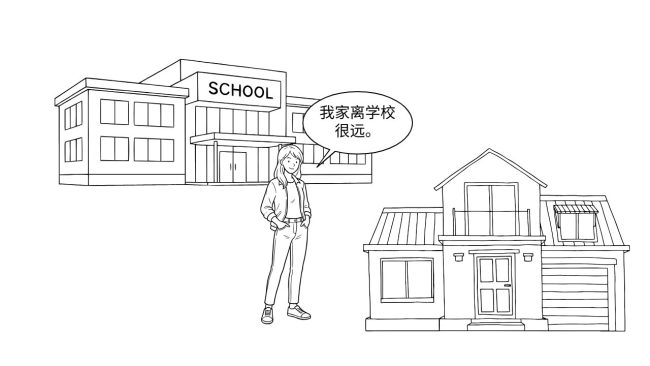
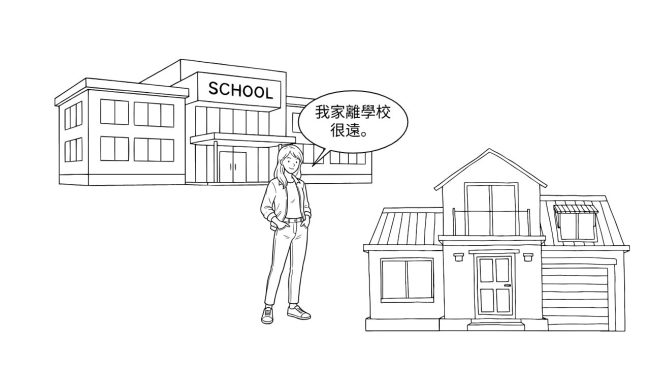
离/離 is placed between the two places you want to tell the distance between. The distance is often expressed with the adjectives yuǎn 远/遠 ‘far’ and jìn ‘near’. The adverb hěn is placed before yuǎn 远/遠 and jìn .

Noun phrase
我家
我家
wǒ jiā
noun phrase
学校
學校
xuéxiào
distance
很远。
很遠。
hěn yuǎn.
My home is far from the school.
Noun phrase
我家
我家
wǒ jiā
noun phrase
学校
學校
xuéxiào
distance
很近。
很近。
hěn jìn.
My home is near the school.

Negation

A sentence with 离/離 is negated with , which is placed in front of the word expressing the distance.

Noun phrase
我家
我家
wǒ jiā
noun phrase
学校
學校
xuéxiào
distance
远。
遠。
yuǎn.
My home is not far from the school.

Question

There are two ways to form a yes-no question. One way is to add the question particle ma 吗/嗎 at the end of the sentence.

Noun phrase
你家
你家
nǐ jiā
noun phrase
学校
學校
xuéxiào
distance
yuǎn
吗?
嗎?
ma?
Is your home far away from the school?

If the word expressing distance is an adjective, such as yuǎn 远/遠 and jìn , a yes-no question can also be formed by reduplicating the adjective and inserting in between. Li 离/離 remains unchanged.

Noun phrase
你家
你家
nǐ jiā
noun phrase
学校
學校
xuéxiào
distance 不 distance
远不远?
遠不遠?
yuǎn bú yuǎn?
Is your home far away from the school?

You can also ask questions using interrogative expressions such as duō yuǎn 多远/多遠 ‘how far’, jǐ gōnglǐ 几公里/幾公里 ‘how many kilometers’ or duōjiǔ 多久 ‘how long’. The verb yǒu can precede the interrogative expressions.

Noun phrase
你家
你家
nǐ jiā
noun phrase
学校
學校
xuéxiào
(有)
(有 )
(有)
(yǒu)
question word distance
多远?
多遠?
duō yuǎn?
How far is your home from the school?
Noun phrase
你家
你家
nǐ jiā
noun phrase
学校
學校
xuéxiào
(有)
(有 )
(有)
(yǒu)
question word distance
几公里?
幾公里?
jī gōnglǐ?
How many kilometers is your home from the school?

With adverbs

Adverbs are not placed directly before 离/離 but before the adjective or verb used to describe the distance.
If the predicate of the sentence is an adjective, there must always be an adverb before the adjective, otherwise it will have a comparative meaning. Hěn can be used as a marker – without emphasis, it does not mean ‘very’.

Noun phrase
我家
我家
wǒ jiā
noun phrase
学校
學校
xuéxiào
adverb
hěn
distance
远。
遠。
yuǎn.
My home is far away from the school.

If you want to modify the extent of the distance, adverbs such as tài ‘too, very’ or yǒudiǎn(r) 有点(儿)/有點(兒) ‘a little’ can be placed before yuǎn 远/遠 and jìn .

Noun phrase
我家
我家
wǒ jiā
noun phrase
学校
學校
xuéxiào
adverb
tài
distance
远了。
遠了。
yuǎn le.
My home is too far from the school.
Noun phrase
我家
我家
wǒ jiā
noun phrase
学校
學校
xuéxiào
adverb
有点儿
有點兒
yǒudiǎnr
distance
远。
遠。
yuǎn.
My home is a little far from the school.

Functions

1. /離 expressing ‘near’ and ‘far’

离/離 is often used with either yuǎn 远/遠 ‘far’ or jìn ‘near’ to indicate a relative distance.

A: 这儿离超市远吗?
這兒離超市遠嗎?
Zhèr lí chāoshì yuǎn ma?
Is the supermarket far from here?
B: 不, 这儿离超市很近。
不, 這兒離超市很近。
Bù, zhèr lí chāoshì hěn jìn.
No, the supermarket is close.

If the first place is known in the context, it can be omitted.

离超市很近。
離超市很近。
Lí chāoshì hěn jìn.
The supermarket is close.

2. /離 expressing specific distance

When talking about a specific distance the verb yǒu can be used before a numerical phrase. If there are no other adverbs preceding it, yǒu can be omitted.

我家离你家有三公里。
我家離你家有三公里。
Wǒ jiā lí nǐ jiā yǒu sān gōnglǐ.
My home is three kilometres from yours.
我家离你家三公里。
我家離你家三公里。
Wǒ jiā lí nǐ jiā sān gōnglǐ.
My home is three kilometres from yours.

If there are adverbs such as zhǐ ’only’ or hái 还/還 ’still’ in the sentence, yǒu is usually required.

超市离我家只有一公里。
超市離我家只有一公里。
Chāoshì lí wǒ jiā zhǐ yǒu yì gōnglǐ.
The supermarket is just one kilometer from my home.

When asking about a specific distance, yǒu duō yuǎn 有多远/有多遠 ‘How far’ is often used. Yǒu can be left out of the sentence. The omission of yǒu may imply that the distance talked about is short.

A: 办公室离你家(有)多远?
辦公室離你家(有)多遠?
Bàngōngshì lí nǐ jiā (yǒu) duō yuǎn?
How far is the office from your home?
B: 办公室离我家(有)二十八公里。
辦公室離我家(有)二十八公里。
Bàngōngshì lí wǒ jiā (yǒu) èrshíbā gōnglǐ.
The office is 28 kilometres from my home.
这儿离学校只有一公里。
這兒離學校只有一公里。
Zhèr lí xuéxiào zhǐ yǒu yì gōnglǐ.
There is only one kilometer from here to the school.

3. /離 expressing distance in time

离/離 can also be used to talk about duration between two moments. When talking about unspecified time yuǎn 远/遠 ‘far’ or jìn ‘near’ can be used.

他的生日离我的生日很近。
他的生日離我的生日很近。
Tā de shēngrì lí wǒ de shēngrì hěn jìn.
His birthday is very close to mine.

When asking about a specific duration (yǒu) duōjiǔ (有)多久 ‘how long’ is often used.

A: 现在离下班还有多久?
現在離下班還有多久?
Xiànzài lí xià bān hái yǒu duōjiǔ?
How long is it now until the end of the workday?
B: 现在离下班还有五分钟。
現在離下班還有五分鐘。
Xiànzài lí xià bān hái yǒu wǔ fēnzhōng.
There are still five minutes until the end of the workday.

When discussing a specific duration, a separable verb denoting the action can be inserted before the time duration.

办公室离超市开车十分钟。
辦公室離超市開車十分鐘。
Bàngōngshì lí chāoshì kāi chē shí fēnzhōng.
The office is ten minutes drive from the supermarket.
餐厅离教室走路五分钟。
餐廳離教室走路五分鐘。
Cāntīng lí jiàoshì zǒu lù wǔ fēnzhōng.
The cafeteria is a five-minute walk from the classroom.

Adverbs like zhǐ and hái 还/還 are also often used when talking about specific time. The verb yǒu is then required after the adverb.

考试离现在只有三天了。
考試離現在只有三天了。
Kǎoshì lí xiànzài zhǐ yǒu sān tiān le.
The exam is only three days from now.
放假离现在还有一个月。
放假離現在還有一個月。
Fàngjià lí xiànzài hái yǒu yí ge yuè.
The holiday is still a month away.

The moment in time preceding 离/離 is often omitted from the sentence, especially when the time is understood as ‘now’.

离我的生日还有一个星期。
離我的生日還有一個星期。
Lí wǒ de shēngrì hái yǒu yí ge xīngqī.
My birthday is still a week away.
离考试还有几个月。
離考試還有幾個月。
Lí kǎoshì hái yǒu jǐ ge yuè.
The exams are still a few months away.
离我开始学中文已经有五个月了。
離我開始學中文已經有五個月了。
Lí wǒ kāishǐ xué Zhōngwén yǐjīng yǒu wǔ ge yuè le.
It has already been five months since I started learning Chinese.

Also check cóng 从/從

Also check cóng 从/從 v.s. lí 离/離