

yǒu
verb – existential

HSK1
.

Yǒu 有 ‘there is; there are’ is one of the non-action verbs used in an existential sentence. The subject of an existential sentence with yǒu 有 is a word or a phrase indicating the location, and the object is an indefinite noun that provides new information. This structure is similar to ‘there is’ or ‘there are’ in English, which conveys the meaning of ‘something exists somewhere’. Note that the verb shì 是 ‘to be’ has a similar usage as well—check Existential sentences for more details.
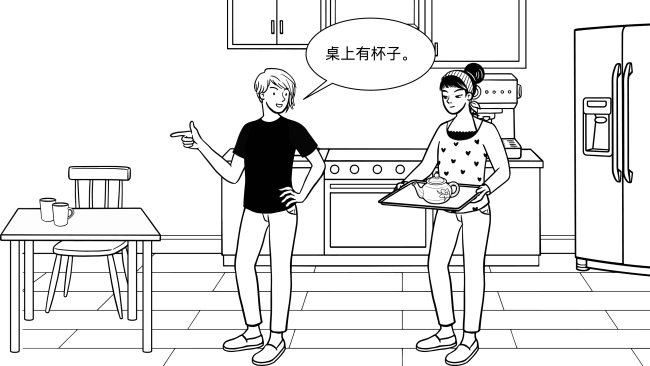
You 有 existential

Structure

Basic form

In an existential sentence, yǒu 有 is placed between the place and the object.

Place
桌子上
桌子上
Zhuōzi shang
yǒu
object
杯子。
杯子。
bēizi.
There is a cup on the table. / There are cups on the table.
教室里
教室里
Jiàoshì lǐ
yǒu
三个人。
三個人。
sān ge rén.
There are three people in the classroom.

Negation

An existential sentence with yǒu 有 can only be negated by méi 没/沒, and 不 cannot be used. The nominal object is usually a generic noun without an attributive phrase consisting of a numeral and a measure word unless such information is the focus of the sentence.

Place
学校
學校
Xuéxiào
méi
yǒu
object
学生。
學生。
xuésheng.
There are no students in the school.
There is no attribute modifying the object xuésheng 学生/學生, which is indefinite and can mean any students in general.
家里没有人。
家裡沒有人。
Jiā lǐ méi yǒu rén.
There is no one at home.

Note: yǒu 有 in a negative sentence can be omitted.

Place
钱包里
錢包里
Qiánbāo lǐ
méi
object
钱。
錢。
qián.
There's no money in the purse.

Question

There are two ways to form a yes-no question with yǒu 有: using the question particle ma 吗/嗎 or combining the affirmative and negative forms into yǒu méi yǒu 有没有/有沒有. The rule of negation also applies to the question form: the object should be generic and not preceded by a ‘numeral-measure word’ attributive unless such information is the focus of the sentence.

Place
碗里面
碗裡面
Wǎn lǐmiàn
yǒu
object
ròu
吗?
嗎?
ma?
Is there any meat in the bowl?
Place
碗里面
碗裡面
Wǎn lǐmiàn
yǒu
没有
没有
沒有
méi yǒu
object
肉?
肉?
ròu?
Is there any meat in the bowl?

We can use yǒu 有 as an affirmative answer and (méi) yǒu 没/沒(有) as a negative answer to the questions above. Yǒu 有 and (méi) yǒu 没/沒(有) can be used solely as predicates when giving a short answer.

有。
有。
Yǒu.
Yes.
有,碗里面有肉。
有,碗裡面有肉。
Yǒu, wǎn lǐmiàn yǒu ròu.
Yes, there is meat in the bowl.
没(有)。
沒(有)
Méi(yǒu).
No.
没(有),碗里面没有肉。
沒(有),碗裡面沒有肉。
Méi(yǒu), wǎn lǐmiàn méi yǒu ròu.
No, there is no meat in the bowl.

With an adverb

Like other verbs, when there is an adverb in a sentence with yǒu 有, the adverb should precede yǒu 有.

桌子上有一些水果,还有一个手机。
桌子上有一些水果,還有一個手機。
Zhuōzi shang yǒu yì xiē shuǐguǒ,hái yǒu yí ge shǒujī.
There are some fruits on the table, and a cell phone.

Omission of the subject

When the context is clear, the subject before yǒu 有 can be omitted.

有风!
有風!
Yǒu fēng!
There is wind! / It’s windy!
The subject omitted here could be a location zhèlǐ 这里/這裡 ‘here’, or a time word xiànzài 现在/現在 ‘now’.

Functions

1. Existential yǒu 有 expressing existence

The existential sentence with yǒu 有 indicates that some people or thing(s) are located or exist in a particular location. The object is usually an indefinite noun and unknown to the listener. In the affirmative form, the object is often modified by an adjective or an attribute consisting of a numeral and a measure word.

房间里有两个孩子。
房間里有兩個孩子。
Fángjiān lǐ yǒu liǎng ge háizi.
There are two children in the room.
The object háizi 孩子 is modified by the numeral attribute liǎng ge 两个.
桌子上有很多书。
桌子上有很多書。
Zhuōzi shang yǒu hěn duō shū.
There are a lot of books on the table.
The object shū 书/書 is modified by an adjectival attribute hěn duō 很多.

The subject indicating location is usually 1) a noun, 2) a noun/personal pronoun + localizer, 3) a localizer, or 4) a pronoun referring to a place.

门口有两辆车。
門口有兩輛車。
Ménkǒu yǒu liǎng liàng chē.
There are two cars at the entrance.
火车上有很多人。
火車上有很多人。
Huǒchē shang yǒu hěn duō rén.
There are many people on the train.
前面有一家书店。
前面有一家書店。
Qiánmiàn yǒu yì jiā shūdiàn.
There's a bookstore in front.
这里没有火车站。
這裡沒有火車站。
Zhèlǐ méi yǒu huǒchēzhàn.
There's no train station here.

Note: The preposition zài 在 ‘in; at’ should not be used before the location.

*在这个国家有很多高山。
*在這個國家有很多高山。
Zài zhè ge guójiā yǒu hěn duō gāo shān.
*There are many high mountains in this country.
这个国家有很多高山。
這個國家有很多高山。
Zhè ge guójiā yǒu hěn duō gāo shān.
There are many high mountains in this country.
*在教室里有三十个学生。
*在教室裡有三十個學生。
Zài jiàoshì lǐ yǒu sānshí ge xuésheng.
*There are thirty students in the classroom.
教室里有三十个学生。
教室裡有三十個學生。
Jiàoshì lǐ yǒu sānshí ge xuésheng.
There are thirty students in the classroom.


In Chinese existential sentences with yǒu 有, a time phrase can occupy the subject position of the sentence instead of a location phrase. This time phrase sets the temporal context of the existence of the object. 

晚上有电影。
晚上有電影。
Wǎnshàng yǒu diànyǐng.
In the evening, there is a movie.
今天没有工作。
今天沒有工作。
Jīntiān méi yǒu gōngzuò.
There's no work today.

Difference between the existential sentences with yǒu 有 and shì

Existential sentences with yǒu 有 generally indicate the presence of one or more objects in a particular place. They introduce new information into the discourse and are typically translated as ‘There is/There are …‘. In contrast, when shì 是 is used, the speaker already presupposes the existence of an object in a given space, and the sentence functions to identify that object (usually a single one). In this case, the meaning is closer to ‘What is there is a …‘.

书架上是书,没有别的东西。
書架上是書,沒有別的東西。
Shūjià shang shì shū, méi yǒu biéde dōngxi.
There are books on the table, there is nothing else.
It implies that there are books on the bookshelf and nothing else.
书架上有书,有杂志也有词典。
書架上有書,有雜誌也有詞典。
Shūjià shang yǒu shū, yǒu zázhì yě yǒu cídiǎn.
There are books on the table, magazines and dictionaries as well.
It implies that there are books on the bookshelf, and other items, like magazines and dictionaries, may also be present.
学校对面是什么?
學校對面是什麼?
Xuéxiào duìmiàn shì shénme?
What's across from the school?
学校对面有图书馆,还有邮局。
學校對面有圖書館,還有郵局。
Xuéxiào duìmiàn yǒu túshūguǎn, hái yǒu yóujú.
There's a library and a post office across from the school.
This question implies that the speaker is unsure if there is something in front of the school and is asking for it, the listener may also answer with a list of things that exist there.
Also check Existential sentence