
Menu

Simple directional complement

HSK2 TBCL2
UBER SDC sim UBER SDC tra

Some verbs carry an inherent sense of spatial direction. These verbs can function as main verbs, often taking a locative object to indicate movement toward or away from a place. For example, verbs such as lái 来/來 ‘come’, ‘go’, shàng ‘ascend’, xià ‘descend’, jìn 进/進 ‘enter’, chū ‘exit’, huí ‘return’ are typical examples of this usage. Here are some examples.

来学校
來學校
lái xuéxiào
come to school
去学校
去學校
qù xuéxiào
go to school
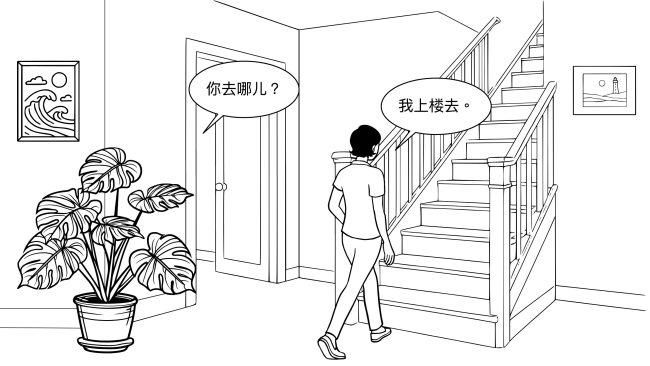
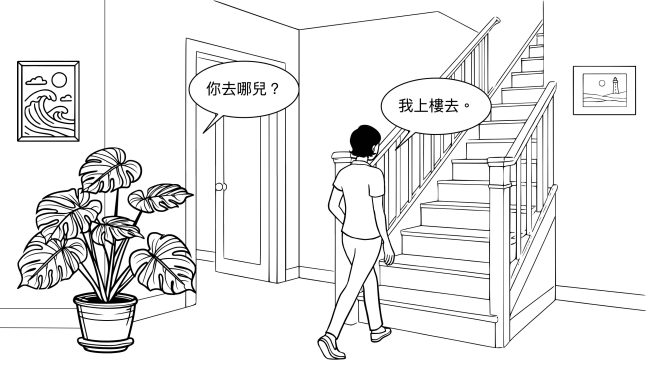
上楼
上樓
shàng lóu
go upstairs
进教室
進教室
jìn jiàoshì
enter the classroom
回家
回家
huí jiā
go home

When these verbs occur after another verb, they no longer serve as the main verb. Instead, they become directional complements. A directional complement is a type of complement which specifies where the action moves — toward, away from, upward, downward, inward, or outward. It reflects the spatial path of the action and its relationship to the speaker’s position. This kind of usage corresponds roughly to expressions such as come in, go out, or walk down in English.

走来学校
走來學校
zǒu lai xuéxiào
walk to school
(implication: the action is toward the speaker – the speaker is in the school)
走去学校
走去學校
zǒu qu xuéxiào
walk to school
(implication: the action is away from the speaker – the speaker is not in the school)
跑上楼
跑上樓
pǎo shàng lóu
run upstairs
带电脑进教室
帶電腦進教室
dài diànnǎo jìn jiàoshì
take the computer into the classroom
拿书回家
拿書回家
ná shū huí jiā
take the book back home

In the above sentences, the main verbs are zǒu 走, pǎo 跑, dài 带/帶 and 拿. They describe the manner of the action, while the directional complements lái 来/來, , shàng , jìn 进/進 and huí describe its direction. It is important to note that some verbs, such as dài 带/帶 and 拿, usually take a direct object. The object can only be omitted when the reference is clear.

Structure

1. Indicating a direction: shàng 上, xià 下, jìn 进/進, chū 出, huí 回, guò 过/過,起 and kāi 开/開

The simple directional complements shàng 上, xià 下, jìn 进/進, chū 出, huí 回, guò 过/過, 起 and kāi 开/開 are placed after the verb and before a locative object or the object. If the action has been completed, the aspect marker le 了 should be placed directly after the directional complement.

Verb
zǒu
simple directional complement 上/下/进/出/回/过/起/开
shàng
(了)
locative object
lóu
walk upstairs
Verb
pǎo
simple directional complement 上/下/进/出/回/过/起/开
chū
(了)
locative object
学校
學校
xuéxiào
run out of school
Verb
dài
simple directional complement 上/下/进/出/回/过/起/开
huí
(了)
le
locative object
jiā
took something back home
Verb
simple directional complement 上/下/进/出/回/过/起/开
(了)
le
object
一本书
一本書
yì běn shū
picked up a book
Verb
fàng
simple directional complement 上/下/进/出/回/过/起/开
kāi
(了)
object
shǒu
let go (of someone’s hand)

2. Indicating towards or away from the speaker: lái 来/來 and

When used as a simple directional complement, lái 来/來 marks movement approaching the speaker’s position, whereas marks movement departing from it. Note that in this usage, lái 来/來 and are normally pronounced in the neutral tone.

Compared to other simple directional complements, the position of lái 来/來 and is a bit more complicated. When there is no object, they are placed directly after the verb.

verb
shàng
simple directional complement 来/去
lai
come up
verb
xià
simple directional complement 来/去
qu
go down
verb
jìn
simple directional complement 来/去
lai
come in
verb
chū
simple directional complement 来/去
qu
go out
verb
simple directional complement 来/去
lai
get up
verb
huí
simple directional complement 来/去
qu
go back
verb
simple directional complement 来/去
lai
take (something) here
verb
dài
simple directional complement 来/去
qu
take (something) there

A locative object should be inserted between the main verb (in the following sentences: chū , xià , huí ) and the complementlái 来/來 or .

verb
chū
locative object
教室
教室
jiàoshì
simple directional complement 来/去
lai
come out of the classroom
verb
xià
locative object
lóu
simple directional complement 来/去
lai
come downstairs
verb
huí
locative object
jiā
simple directional complement 来/去
qu
go back home

3. Making a request

When making a request, lái 来/來 and should be placed after the object.

verb
mǎi
object
一些东西
一些东西
yìxiē dōngxi
simple directional complement 来/去
lai
tag question
,好吗?
,好吗?
hǎo ma?
Buy some things and bring them here, okay?
verb
sòng
object
huā
simple directional complement 来/去
qu
particle
吧!
吧!
ba!
Send some flowers (there)!

4. With the aspect marker 了

If the action has been completed, lái 来/來 and can be placed after or before the object. In this usage, the aspect marker le 了 is often used to indicate the completion of the action. Note that if the object is not quantified, it is usually placed before lái 来/來 and .

subject
verb
mǎi
le
object
水果
水果
shuǐguǒ
simple directional complement 来/去
来。
來。
lai.
He bought some fruit and brought it here.
subject
verb
sòng
le
object
huā
simple directional complement 来/去
来。
來。
lai.
He sent flowers (here).
subject
verb
sòng
le
object
一些花
一些花
yìxiē huā
simple directional complement 来/去
去。
去。
qu.
He sent some flowers (there).
subject
verb
mǎi
simple directional complement 来/去
lai
le
object
很多东西。
很多東西。
hěn duō dōngxi.
He bought many things and brought them here.
subject
verb
sòng
simple directional complement 来/去
qu
le
object
一些花。
一些花。
yìxiē huā.
He sent some flowers (there).

5. With prepositional phrases

Some prepositions that relate to the direction of movement can be placed before the verb-directional complement structure, such as cóng 从/從 ‘from’ (marking the starting point of an action) or xiàng 向 ‘towards’ (indicating the goal or destination of the action).

prepositional phrase
从学校
從學校
cóng xuéxiào
verb + (object) + simple directional complement 来/去
跑来
跑來
pǎo lai
run from the school (to here)
prepositional phrase
从车上
從車上
cóng chē shang
verb + (object) + simple directional complement 来/去
拿一些东西来
拿一些東西來
ná yìxiē dōngxi lai
take some things here from the car
prepositional phrase
向我
向我
xiàng wǒ
verb + (object) + simple directional complement 来/去
走来
走來
zǒu lai
walk toward me
prepositional phrase
向那边
向那邊
xiàng nà biān
verb + (object) + simple directional complement 来/去
开去
開去
kāi qu
drive toward that direction

Directional complements may also occur with non-directional prepositions, such as gěi 给/給.

prepositional phrase
给他
給他
gěi tā
verb + (object) + simple directional complement 来/去
带了很多礼物去
帶了很多禮物去
dài le hěn duō lǐwù qu
bring lots of gifts to him

6. With following action(s)

A directional complement can be followed by another verb or action. In this construction, the second action is the purpose of the former (“in order to”) or simply follows the former (“and then”).

学生走进教室上课。
學生走進教室上課。
Xuésheng zǒu jìn jiàoshì shàng kè.
The students walk into the classroom for class.
爸爸走出房间喝水。
爸爸走出房間喝水。
Bàba zǒu chū fángjiān hē shuǐ.
Dad walked out of the room to drink some water.
下课以后,大家都跑来问问题。
下課以後,大家都跑來問問題。
Xià kè yǐhòu, dàjiā dōu pǎo lai wèn wèntí.
After class, everyone ran to me and ask questions.

For more information about the directional complement, also check compound directional complement