

 en
en cs
cs da
da de
de it
it pl
pl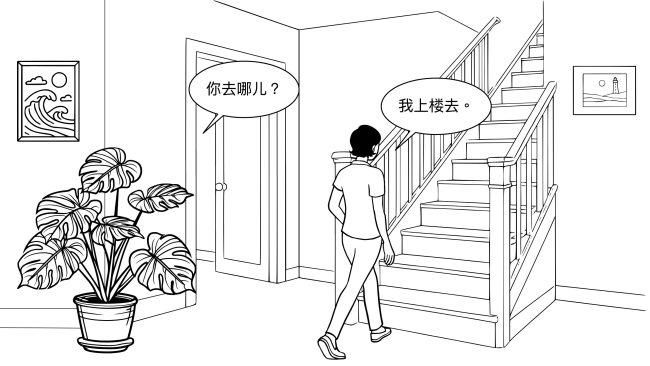
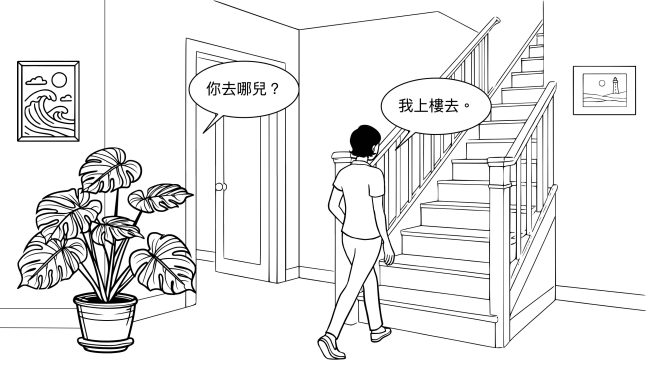
Some verbs carry an inherent sense of spatial direction. These verbs can function as main verbs, often taking a locative object to indicate movement toward or away from a place. For example, verbs such as lái 来/來 ‘come’, qù 去 ‘go’, shàng 上 ‘ascend’, xià 下 ‘descend’, jìn 进/進 ‘enter’, chū 出 ‘exit’, huí 回 ‘return’ are typical examples of this usage. Here are some examples.
When these verbs occur after another verb, they no longer serve as the main verb. Instead, they become directional complements. A directional complement is a type of complement which specifies where the action moves — toward, away from, upward, downward, inward, or outward. It reflects the spatial path of the action and its relationship to the speaker’s position. This kind of usage corresponds roughly to expressions such as come in, go out, or walk down in English.
In the above sentences, the main verbs are zǒu 走, pǎo 跑, dài 带/帶 and ná 拿. They describe the manner of the action, while the directional complements lái 来/來, qù 去, shàng 上, jìn 进/進 and huí 回 describe its direction. It is important to note that some verbs, such as dài 带/帶 and ná 拿, usually take a direct object. The object can only be omitted when the reference is clear.
Structure
1. Indicating a direction: shàng 上, xià 下, jìn 进/進, chū 出, huí 回, guò 过/過, qǐ 起 and kāi 开/開
The simple directional complements shàng 上, xià 下, jìn 进/進, chū 出, huí 回, guò 过/過, qǐ 起 and kāi 开/開 are placed after the verb and before a locative object or the object. If the action has been completed, the aspect marker le 了 should be placed directly after the directional complement.
2. Indicating towards or away from the speaker: lái 来/來 and qù 去
When used as a simple directional complement, lái 来/來 marks movement approaching the speaker’s position, whereas qù 去 marks movement departing from it. Note that in this usage, lái 来/來 and qù 去 are normally pronounced in the neutral tone.
Compared to other simple directional complements, the position of lái 来/來 and qù 去 is a bit more complicated. When there is no object, they are placed directly after the verb.
A locative object should be inserted between the main verb (in the following sentences: chū 出, xià 下, huí 回) and the complementlái 来/來 or qù 去.
3. Making a request
When making a request, lái 来/來 and qù 去 should be placed after the object.
4. With the aspect marker 了
If the action has been completed, lái 来/來 and qù 去 can be placed after or before the object. In this usage, the aspect marker le 了 is often used to indicate the completion of the action. Note that if the object is not quantified, it is usually placed before lái 来/來 and qù 去.
5. With prepositional phrases
Some prepositions that relate to the direction of movement can be placed before the verb-directional complement structure, such as cóng 从/從 ‘from’ (marking the starting point of an action) or xiàng 向 ‘towards’ (indicating the goal or destination of the action).
Directional complements may also occur with non-directional prepositions, such as gěi 给/給.
6. With following action(s)
A directional complement can be followed by another verb or action. In this construction, the second action is the purpose of the former (“in order to”) or simply follows the former (“and then”).
For more information about the directional complement, also check compound directional complement