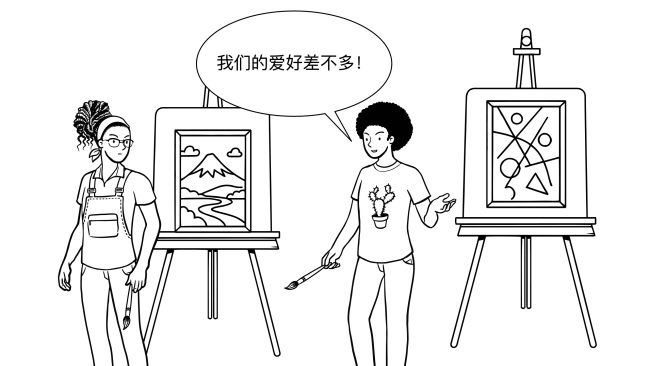
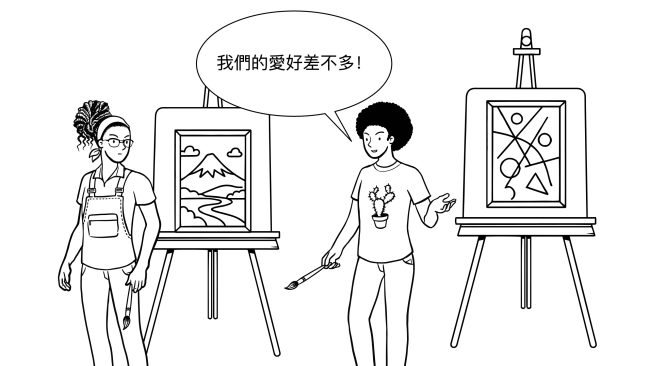
Chàbuduō 差不多 can function either as an adjective or an adverb. It is commonly used to express that two or more things differ very little or are nearly equivalent in terms of degree, scope, time, distance, or quantity. It may also convey a rough estimate, indicating an approximate value or close approximation.
Structure
Basic form
When used as an adjective, chàbuduō 差不多 ‘more or less the same’ typically functions as a predicate and is placed directly after the subject.
subject
我们的爱好
我們的愛好
Wǒmen de àihào
Our hobbies are similar.
subject
这三件衣服的颜色
這三件衣服的顏色
Zhè sān jiàn yīfu de yánsè
The colors of these three pieces of clothing are about the same.
subject
今天的天气和昨天的
今天的天氣和昨天的
Jīntiān de tiānqì hé zuótiān de
Today's weather is about the same as yesterday's.
(Literally: Today’s weather and yesterday’s weather are more or less the same.)
The adverb chàbuduō 差不多 ‘more or less, about, almost, nearly’ can be used before adjectives, numeral phrases, or verbs. It is often followed by words indicating quantity or degree.
They are about the same height.
subject
他哥哥和我弟弟
他哥哥和我弟弟
Tā gēge hé wǒ dìdi
His older brother and my younger brother are about the same height.
subject
我的同学跟我
我的同學跟我
Wǒ de tóngxué gēn wǒ
My classmate is about the same age as me.
subject
这件衣服
這件衣服
Zhè jiàn yīfu
numeral phrase
一百块。
一百塊。
yì bǎi kuài.
This piece of clothing costs about ¥100.
object
五双鞋。
五双鞋。
wǔ shuāng xié.
My father has about five pairs of shoes.
Questions
Chàbuduō 差不多 can be combined with the question particle ma 吗/嗎.
subject
你们的爱好
你們的愛好
Nǐmen de àihào
Are your hobbies similar?
subject
今天的天气跟昨天的
今天的天氣跟昨天的
Jīntiān de tiānqì gēn zuótiān de
Is today's weather about the same as yesterday's?
Are they about the same height?
subject
他哥哥和我弟弟
他哥哥和我弟弟
Tā gēge hé wǒ dìdi
Are his older brother and my younger brother about the same height?
Apart from the question particle ma 吗/嗎, shí bu shì 是不是 can be also be used with chàbuduō 差不多 to form a question.
subject
你们的爱好
你們的愛好
Nǐmen de àihào
Are your hobbies similar?
subject
今天的天气跟昨天的
今天的天氣跟昨天的
Jīntiān de tiānqì gēn zuótiān de
Is today's weather about the same as yesterday's?
Are they about the same height?
subject
他哥哥和我弟弟
他哥哥和我弟弟
Tā gēge hé wǒ dìdi
Are his older brother and my younger brother about the same height?
Chàbuduō 差不多 can also occur in question-word questions when asking for a rough estimation.
question word
多少钱?
多少钱?
duōshǎo qián?
How much does this book cost?
question word
几双鞋?
幾雙鞋?
jǐ shuāng xié?
About how many pairs of shoes does your dad have?
With modal verbs and other adverbs
When a sentence contains a modal verb, chàbuduō 差不多 is usually placed before the modal verb.
You can come at around three o’clock.
It’s about time for us to leave.
When used together with the adverb zhǐ 只 ‘only, just’, chàbuduō 差不多 can appear before zhǐ 只 or before the numeral phrase. When chàbuduō 差不多 is used before the numeral phrase, it indicates that the quantity is a rough estimation.
numeral phrase
三本书。
三本書。
sān běn shū.
I can only buy about three books.
numeral phrase
两个小时。
兩個小時。
liǎng ge xiǎoshí.
He slept for only about two hours.
numeral phrase
三本书。
三本書。
sān běn shū.
I can only buy around three books.
numeral phrase
两个小时。
兩個小時。
liǎng ge xiǎoshí.
He slept for only about two hours.
Functions
Indicating two or more things are nearly the same or very similar
Chàbuduō 差不多 can be used to show that two or more things are almost the same in degree, scope, time, distance, or quantity. This use can be understood as chàbuduō yíyàng 差不多一样/差不多一樣 ‘more or less the same’; yíyàng 一样/一樣 can be omitted.
这些手机都差不多(一样)。
這些手機都差不多(一樣)。
Zhèxiē shǒujī dōu chàbuduō (yíyàng).
These phones are all pretty much the same.
今天跟昨天差不多(一样)热。
今天跟昨天差不多(一樣)熱。
Jīntiān gēn zuótiān chàbuduō (yíyàng) rè.
Today is about as hot as yesterday.
Chàbuduō 差不多 indicating a rough estimate
Chàbuduō 差不多 can also indicate an approximate or rough estimate. It is often followed by words indicating quantity.
妈妈差不多准备好了。
媽媽差不多準備好了。
Māma chàbuduō zhǔnbèi hǎo le.
Mom is almost ready.
英文课差不多要开始了。
英文課差不多要開始了。
Yīngwénkè chàbuduō yào kāishǐ le.
English class is about to start.
现在差不多下午三点。
現在差不多下午三點。
Xiànzài chàbuduō xiàwǔ sān diǎn.
It’s about 3 p.m. now.
他差不多学了一年的中文。
他差不多學了一年的中文。
Tā chàbuduō xué le yì nián de Zhōngwén.
He has studied Chinese for about a year.
我们写汉字写了差不多两个小时。
我們寫漢字寫了差不多兩個小時。
Wǒmen xiě hànzì xiě le chàbuduō liǎng ge xiǎoshí.
We’ve been writing Chinese characters for about two hours.
In spoken Chinese, when indicating a rough estimate, chàbuduō le 差不多了 ‘almost’ is often used as a brief response.
A: 你看完这本书了吗?
A: 你看完這本書了嗎?
Nǐ kàn wán zhè běn shū le ma?
Have you finished reading this book?
B: 差不多了。
B: 差不多了。
Chàbuduō le.
B: Almost.
A: 你们都准备好了吗?
A: 你們都準備好了嗎?
Nǐmen dōu zhǔnbèi hǎo le ma?
Are you ready?
B: 差不多了。
B: 差不多了。
Chàbuduō le.
B: Almost.


 en
en cs
cs da
da de
de it
it pl
pl