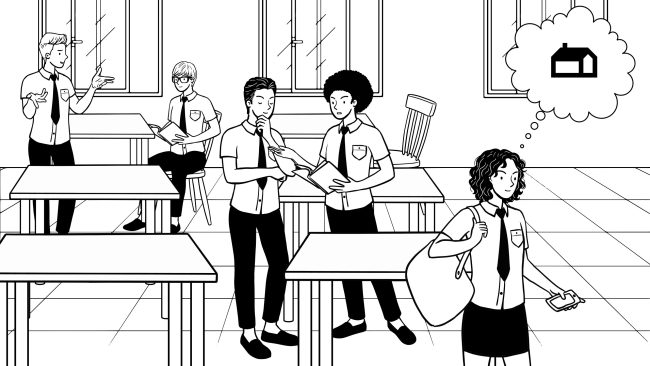
The pattern yī… jiù… 一…… 就…… is used to show that one action happens immediately after another, meaning ‘as soon as…, then…’.
Structure
Basic form
The pattern yī… jiù… 一…… 就…… ‘as soon as…, then…’ is used to show that one action or situation happens immediately after another. The adverb yī 一 introduces the first clause and the adverb jiù 就 introduces the second clause, each placed before a verb, an adjective or a verb phrase. If both actions happened in the past, the modal particle le 了 is used at the end of the sentence. For habitual activities, the modal particle le 了 is not used.
verb/adjective/verb phrase 1
下课
下課
xià kè
verb/adjective/verb phrase 2
回家。
回家。
huí jiā.
I go home as soon as class is over.
verb/adjective/verb phrase 1
见到妈妈
見到媽媽
jiàn dào māma
verb/adjective/verb phrase 2
开心
開心
kāixīn
The child became happy as soon as he saw his mother.
verb/adjective/verb phrase 1
累
累
lèi
verb/adjective/verb phrase 2
不想说话。
不想說話。
bù xiǎng shuō huà.
As soon as I get tired, I don’t feel like talking.
The two actions may be performed by the same subject or by two different subjects. In this case, the second subject comes immediately before jiù 就.
verb/adjective/verb phrase 1
起床
起床
qǐ chuáng
verb/adjective/verb phrase 2
出门
出門
chū mén
He left as soon as I got up.
verb/adjective/verb phrase 1
说
說
shuō
verb/adjective/verb phrase 2
懂
懂
dǒng
I understood as soon as the teacher explained it.
verb/adjective/verb phrase 1
生气
生氣
shēngqì
verb/adjective/verb phrase 2
哭。
哭。
kū.
Younger brother cries whenever mum gets angry.
With adverbs
The adverbs indicating frequency, scope or time can be added before yī 一.
verb/adjective/verb phrase 1
上课
上課
shàng kè
verb/adjective/verb phrase 2
睡觉 。
睡覺 。
shuì jiào.
He often falls asleep as soon as class starts.
verb/adjective/verb phrase 1
放假
放假
fàng jià
verb/adjective/verb phrase 2
高兴
高興 。
gāoxìng.
I also become happy as soon as the holidays begin.
verb/adjective/verb phrase 1
回来
回來
huílái
verb/adjective/verb phrase 2
睡
睡
shuì
She just fell asleep as soon as I got back.
Functions
1. Expressing a close succession of two events
The pattern yī… jiù… 一…… 就…… ‘as soon as…, then…’ is used to show that one action happens immediately after another action occurs or is completed. Because of this close temporal relationship, the pattern may also imply a cause-and-effect relation between the two actions. This structure is typically used in two contexts: one-time actions and habitual situations.
In a one-time action, the meaning is that the second action or situation takes place ‘as soon as’ the first situation is completed. These sentences often end with le 了, reinforcing that both actions have already happened.
他一放学就回家了。
他一放學就回家了。
Tā yī fàngxué jiù huí jiā le.
As soon as school was over, he went home.
这道题不难,我一看就会做。
這道題不難,我一看就會做。
Zhè dào tí bù nán, wǒ yī kàn jiù huì zuò.
This exercise wasn’t difficult. As soon as I looked at it, I knew how to do it.
今天早上他一跟我说话,我就生气了。
今天早上他一跟我說話,我就生氣了。
Jīntiān zǎoshang tā yī gēn wǒ shuō huà, wǒ jiù shēngqì le.
This morning, as soon as he spoke to me, I got angry.
This pattern can also link actions performed by different subjects.
爸爸一去上班,弟弟就哭。
爸爸一去上班,弟弟就哭。
Bàba yī qù shàng bān, dìdi jiù kū.
As soon as dad goes to work, my little brother cries.
天气一冷,小狗就不想出门。
天氣一冷,小狗就不想出門。
Tiānqì yī lěng, xiǎo gǒu jiù bù xiǎng chū mén.
As soon as the weather gets cold, the puppy doesn’t want to go out.
In a habitual situation, the meaning is that ‘whenever’ the first action or situation occurs, the second action or situation immediately follows.
他身体不好,一吃油就难受。
他身體不好,一吃油就難受。
Tā shēntǐ bù hǎo, yī chī yóu jiù nánshòu.
His health isn’t good. Whenever he eats something oily, he feels uncomfortable.
我同事一累就喝咖啡。
我同事一累就喝咖啡。
Wǒ tóngshì yī lèi jiù hē kāfēi.
My colleague drinks coffee whenever he is tired.
My colleague drinks coffee whenever he is tired.


 en
en cs
cs da
da de
de it
it pl
pl