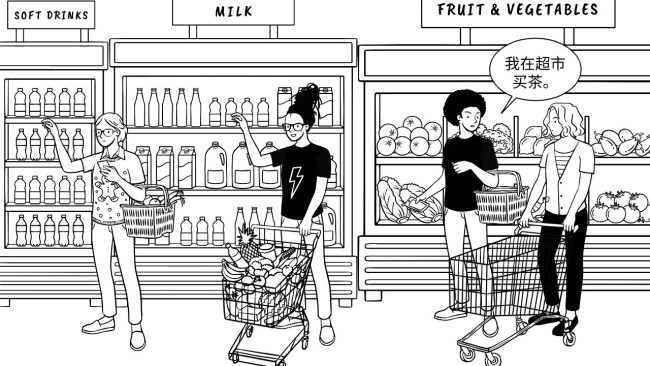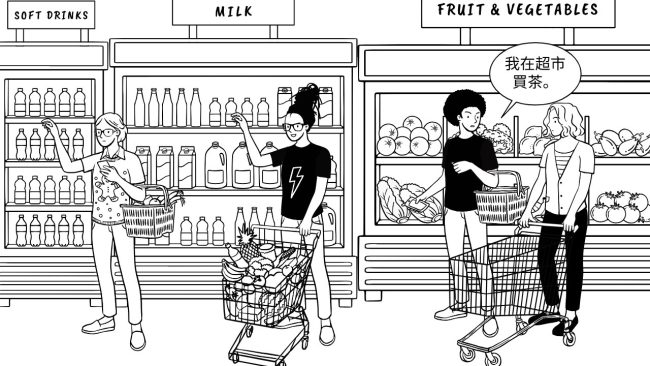

zài
preposition

HSK1 TBCL1

Zài has multiple functions in Chinese. One of its primary uses is as a preposition to show where something happens, similar to ‘at‘, ‘in‘, or ‘on‘ in English. In this context, the location must be placed after zài , and both zài and the location precede the verb.

Structure

Basic form

Zài and the location must come before the verb, so the place precedes the action. A simple way to remember this rule is: “You have to arrive at the place before the action can take place there.”

Subject
在 + place
在超市
在超市
zài chāoshì
verb
mǎi
object
茶。
茶。
chá
I buy tea at the supermarket.

Negation

When you want to say an action is not performed at the place indicated by the prepositional phrase, the negation adverb is placed before zài .

Subject
在 + place
在超市
在超市
zài chāoshì
verb
mǎi
object
茶。
茶。
chá
I do not buy tea at the supermarket.

Question

There are two ways to form a yes-no question. One way is to add the question particle ma 吗/嗎 at the end of the sentence.

Subject
在 + place
在超市
在超市
zài chāoshì
verb
mǎi
object
chá
ma
吗?
嗎?
ma?
Did you buy tea at the supermarket?

Another way to form a yes-no question is by combining the affirmative and negative forms of the verb. The focus of the question is then on the action itself.

Subject
在 + place
在超市
在超市
zài chāoshì
verb 不/没 verb
买没买
買沒買
mǎi mei mǎi
object
茶?
茶?
chá?
Did you buy tea at the supermarket? (The focus is on whether the person bought tea or not.)

If the affirmative and negative forms of the preposition are combined into zài bu zài 在不在, the focus of the question is on the location.

Subject
在 + 不 + 在
在不在
在不在
zài bu zài
place
超市
超市
chāoshì
verb
mǎi
object
茶?
茶?
chá?
Are you buying tea in the supermarket? (The focus is on where the person buys the tea.)

To ask where something happens, use zài + nǎr 哪儿/哪兒.

Subject
在 + 哪儿
在哪儿
在哪兒
zài nǎr
verb
mǎi
object
茶?
茶?
chá?
Where do you buy tea?

With modal verbs

Modal verbs, such as xiǎng ‘to want’, precede the prepositional phrase with zài when they refer to performing the action in the location specified by the prepositional phrase.

Subject
modal verb
xiǎng
在 + place
在超市
在超市
zài chāoshì
verb
mǎi
object
茶。
茶。
chá.
I want to buy tea at the supermarket.

With adverbs

Adverbs, such as ‘also’ and dōu ‘both, all’ are usually placed before zài and the location.

Subject
adverb
在 + place
在超市
在超市
zài chāoshì
verb
mǎi
object
茶。
茶。
chá.
I also buy tea at the supermarket.
Subject
我们
我們。
Wǒmen .
adverb
dōu
在 + place
在家
在家
zài jiā
verb
chī
object
饭。
飯。
fàn.
We are all eating at home.

With time expressions

When a sentence includes a time expression, such as zuótiān 昨天 ’yesterday’ or xiànzài 现在/現在 ‘now’, the time expression comes before zài and the location. Remember that most Chinese sentences follow the Time – Place – Action order.

Subject
time
昨天
昨天
zuótiān
在 + place
在超市
在超市
zài chāoshì
verb
mǎi
object
茶。
茶。
chá.
I bought tea at the supermarket yesterday.
Subject
我们
我們
Wǒmen    
time
现在
現在
xiànzài 
在 + place
在家
在家
zài jiā
verb
chī
object
饭。
飯。
fàn.
We eat at home now.

Functions

Depending on the context the preposition zài can mean ‘at’, ‘in’ or ‘on’.

1. Zài 在 as ‘at’

我在大学学习。
我在大學學習。
Wǒ zài dàxué xuéxí.
I study at the university.
他们在门口等我。
他们在门口等我。
Tāmen zài ménkǒu děng wǒ.
They are waiting for me at the door.
我今天晚上想在家看电视。
我今天晚上想在家看電視。
Wǒ jīntiān wǎnshang xiǎng zài jiā kàn diànshì.
I want to watch TV at home tonight.
A: 你在哪儿工作? Where do you work?
你在哪兒工作?
Nǐ zài nǎr gōngzuò?
Where do you work?
B: 我在学校工作。
我在學校工作。
Wǒ zài xuéxiào gōngzuò.
I work at a school.

2. Zài 在 as ‘in’

我在办公室工作。
我在辦公室工作。
Wǒ zài bàngōngshì gōngzuò.
I work in an office.
我明年会在中国学习。
我明年會在中國學習。
Wǒ míngnián huì zài Zhōngguó xuéxí.
I will be studying in China next year.
我在北京上高中。
我在北京上高中。
Wǒ zài Běijīng shàng gāozhōng.
I went to high school in Beijing.
学生每天都在教室练习写字。
學生每天都在教室練習寫字。
Xuéshēng měi tiān dōu zài jiàoshì liànxí xiě zì.
The students practice writing characters in the classroom every day.

3. Zài 在 as ‘on’

我在手机上看书。
我在手機上看書。
Wǒ zài shǒujī shang kàn shū.
I am reading a book on my phone.
我常常在地铁上喝茶。
我常常在地鐵上喝茶。
Wǒ chángcháng zài dìtiě shang hē chá.
I often drink tea on the metro.
他们在桌子上跳舞。
他們在桌子上跳舞。
Tāmen zài zhuōzi shang tiào wù.
They dance on the table.

Also check zài 在 indicating existence/as a verb

Also check zài 在 as a complement

Also check The Progressive Aspect Marker zài

Also check Noun-localizer