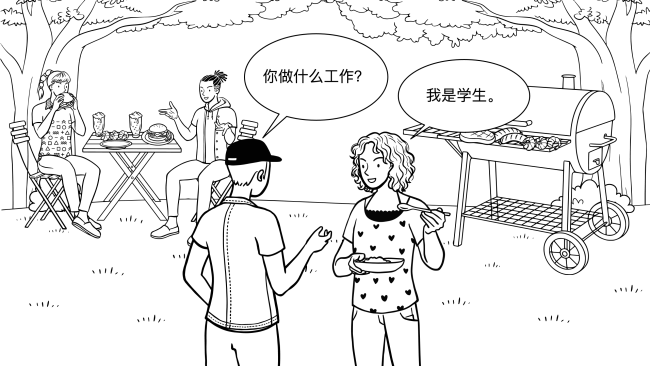
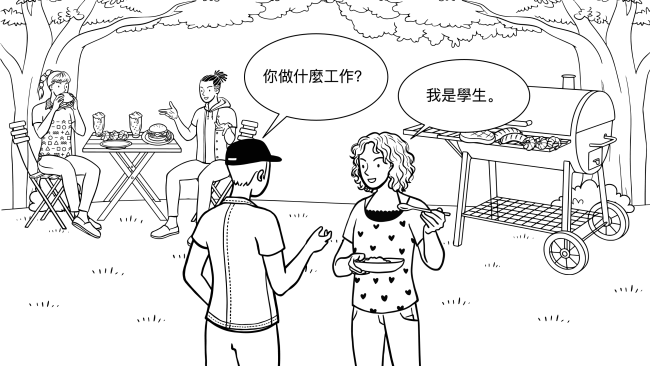
Although shì 是 ‘to be’ is a verb, there are several distinctions between shì 是 and the other verbs. It is a linking verb that can either express identification, categorization, or existence. The verb shì 是 connects the subject and object of the sentence; both of them are usually nouns and pronouns. The verb shì 是 is used similarly to the verb ‘to be’ in English. However, in contrast to English, shì 是 cannot be followed by an adjectival predicate.
When shì 是 is used to express existence, the subject is often a location or time.
Structure
Basic form
Shì 是 stands between the subject and the object.
Negation
A sentence with shì 是 can only be negated by bù 不.
Question
There are two ways to form a yes-no question with shì 是: using the question particle ma 吗/嗎 or using the affirmative-negative form shì bú shì 是不是.
We can use shì (de) 是(的) or duì 对/對 as an affirmative answer and bú (shì) 不(是) as a negative answer to the questions above. Shì (de) 是(的), duì 对/對, or bú (shì) 不(是) can be used solely as predicates when giving a short answer.
是(的)。/ 对。
是(的)。/ 對。
Shì (de). / Duì.
Yes.
是(的),我是小王。
是(的),我是小王。
Shì (de), wǒ shì Xiǎo Wáng.
Yes, I am Xiǎo Wáng.
对,我是小王。
對,我是小王。
Duì, wǒ shì Xiǎo Wáng.
Yes, I am Xiǎo Wáng.
不(是)。/ 不对。
不(是)。/ 不對。
Bú (shì). / Bú duì.
No.
不(是),我不是小王。
不(是),我不是小王。
Bú (shì), wǒ bú shì Xiǎo Wáng.
No, I am not Xiǎo Wáng.
不对,我不是小王。
不對,我不是小王。
Bú duì, wǒ bú shì Xiǎo Wáng.
No, I am not Xiǎo Wáng.
In comparison to shì 是, shì de 是的 is more emphatic and also slightly more formal. It can be also used as reply to sentences, which include other verbs than shì 是. However, in this case a full answer is expected, including the original verb.
你喜欢喝茶吗?
你喜歡喝茶嗎?
Nǐ xǐhuan hē chá ma?
Do you like to drink tea?
是的,很喜欢。
是的,很喜歡。
Shì de, hěn xǐhuan.
That is right, I do.
With an adverb
Like other verbs, when there is an adverb in a sentence with shì 是, the adverb should precede shì 是.
It's really not Monday today.
With a modal verb
The modal verb should be placed before shì 是 ‘to be’.
object
好天气。
好天氣。
hǎo tiānqì.
It will be nice weather tomorrow.
Functions
1. Shì 是 expressing identification
The main function of shì 是 is to express that the items linked have an equational relationship. That is, the subject is equal to the object. The subject is usually expressed by a noun or pronoun, and the object is a noun. The subject and the object are usually interchangeable without changing the meaning of the sentence. The difference is in the informational structure: new information appears at the end of the sentence.
李小姐是我们的中文老师。
李小姐是我們的中文老師。
Lǐ xiǎojiě shì wǒmen de Zhōngwén lǎoshī.
Ms. Li is our Chinese teacher.
The subject Lǐ xiǎojiě 李小姐 equals to the object wǒmen de Zhōngwén lǎoshī 我们的中文老师/我們的中文老師. The position of the subject and the object can be switched: Wǒmen de Zhōngwén lǎoshī shì Lǐ xiǎojiě. 我们的中文老师是李小姐/我們的中文老師是李小姐。Our Chinese teacher is Ms. Li.
我是他的女朋友。
我是他的女朋友。
Wǒ shì tā de nǚpéngyou.
I am his girlfriend.
Wǒ 我 = tā de nǚpéngyou 他的女朋友. The subject and the object are reversible: Tā de nǚpéngyou shì wǒ. 他的女朋友是我。
2. Shì 是 expressing categorization
Shì 是 also often indicates the category to which the subject belongs. The subject can be nouns, pronouns, numeral phrases, verbal phrases, or subject-predicate clauses. Unlike the function of expressing identification, the subject and the object here are not interchangeable in this case.
王先生是英国人。
王先生是英國人。
Wáng xiānsheng shì Yīngguórén.
Mr. Wang is British.
Wáng xiānsheng 王先生 is identified as a member of the category Yīngguórén 英国人/英國人.
你是这个学校的学生吗?
你是這個學校的學生嗎?
Nǐ shì zhè ge xuéxiào de xuésheng ma?
Are you a student at this school?
The speaker is asking if the subject nǐ 你 belongs to the category of the object zhè ge xuéxiào de xuésheng 这个学校的学生/這個學校的學生.
这是纸做的球。
這是紙做的球。
Zhè shì zhǐ zuò de qiú.
This is a ball made of paper.
The demonstrative pronoun zhè 这/這 refers to the object qiú 球, which is modified by a subject-predicate clause zhǐ zuò de 纸做的/紙做的.
Note: shì 是 is often omitted when the object includes a number, such as money, age, time, date, height, and weight.
今天(是)三月十号。
今天(是)三月十號。
Jīntiān (shì) sān yuè shí hào.
Today is March 10th.
奶茶(是)五十块钱。
奶茶(是)五十塊錢。
Nǎichá (shì) wǔshí kuài qián.
Milk tea is 50 dollars.
妹妹(是)十八岁。
妹妹(是)十八歲。
Mèimei (shì) shíbā suì.
My younger sister is eighteen years old.
Note: One distinction between shì 是 and regular verbs is that shì 是 is not related to action. Therefore, it cannot be followed by aspect markers zhe 着/著, guo 过/過, or le 了 in the sense of action completion. If necessary, time words can be added at the beginning of the sentence or before shì 是 as an adverbial or before the object as an attributive to indicate the time of the situation.
这是她以前的男朋友。
這是她以前的男朋友。
Zhè shì tā yǐqián de nánpéngyou.
This is her ex-boyfriend.
十年以前,他还是一个学生。
十年以前,他還是一個學生。
Shí nián yǐqián, tā hái shì yí ge xuésheng.
Ten years ago, he was still a student.
Shí nián yǐqián 十年以前 is added at the beginning of the sentence as a temporal adverbial.
However, the modal particle le 了2 can be added at the end of the sentence with shì 是 ‘to be’ when indicating a new situation.
我明天就是大学生了。
我明天就是大學生了。
Wǒ míngtiān jiù shì dàxuéshēng le.
I'll be a college student tomorrow.
Dàxuéshēng 大学/學生 is a new situation that will be effective tomorrow, so the modal particle le 了2 is added at the end of the sentence.
3. Shì 是 expressing existence
Shì 是 can be used to indicate the state of existence of a person or object. The subject is a location word or phrase and the object can be a definite or indefinite noun. The subject and the object are not reversible.
床旁边是桌子。
床旁邊是桌子。
Chuáng pángbiān shì zhuōzi.
There's a table next to the bed.
The subject chuáng pángbiān 床旁边/床旁邊 is the location where the object zhuōzi 桌子 exists. Without specification, the object zhuōzi 桌子 can be definite or indefinite. That is, it can be a particular table or any table in general.
火车站后面是一个学校。
火車站後面是一個學校。
Huǒchēzhàn hòumiàn shì yí ge xuéxiào.
There's a school behind the train station.
The subject huǒchēzhàn hòumiàn 火车站后面/火車站後面 indicates the location of the indefinite object yí ge xuéxiào 一个学校/一個學校.
This usage belongs to the special structure of ‘existential sentence’ and is used similarly as the verb yǒu 有 ‘there is; there are’. However, there is a slight difference in meaning and usage between the two verbs (see also Verb yǒu 有 ‘there is; there are‘ for more details).
Difference between the existential sentences with yǒu 有 ‘there is; there are’ and shì 是 ‘to be‘
Existential sentences with yǒu 有 generally express an existence that the speaker perceives as temporary or casual, while those with shì 是 tend to indicate a more permanent existence. Consider the following examples:
书架上是书,没有别的东西。
書架上是書,沒有別的東西。
Shūjià shang shì shū, méi yǒu biéde dōngxi.
There are books on the bookshelf, there is nothing else.
It implies that there are books on the bookshelf and nothing else.
书架上有书,有杂志也有词典。
書架上有書,有雜誌也有詞典。
Shūjià shang yǒu shū, yǒu zázhì yě yǒu cídiǎn.
There are books on the bookshelf, a magazine and a dictionary as well.
It implies that there are books on the bookshelf, and other items, like magazines and dictionaries, may also be present.
学校对面是什么?
學校對面是什麼?
Xuéxiào duìmiàn shì shénme?
What's opposite the school?
学校对面是图书馆。
學校對面是圖書館。
Xuéxiào duìmiàn shì túshūguǎn.
There's a library opposite the school.
This question implies that the speaker already knows there is something in front of the school and simply wants to identify it.
学校对面有什么?
學校對面有什麼?
Xuéxiào duìmiàn yǒu shénme?
Is there anything opposite the school?
学校对面有图书馆,还有邮局。
學校對面有圖書館,還有郵局。
Xuéxiào duìmiàn yǒu túshūguǎn, hái yǒu yóujú.
There's a library and a post office opposite the school.
This question implies that the speaker is unsure if there is something opposite the school and is asking about it, the listener may answer also with a list of things that may be there.
Also check Existential verb 有
Also check Existential sentence


 en
en cs
cs da
da de
de it
it pl
pl