

 en
en cs
cs da
da de
de it
it pl
plIn some comparative constructions in Chinese, the verb yǒu 有 is used not in its usual sense of ‘to have’ or ‘to exist’, but as part of a comparison.
The negative form, méi yǒu 没有/沒有, is very common and functions similarly to the English phrase ‘not as… as’. This structure indicates that the first item or person being compared does not possess the feature compared (e.g. degree, quality, characteristics, or condition) to the same extent as the second.
Structure
Basic form
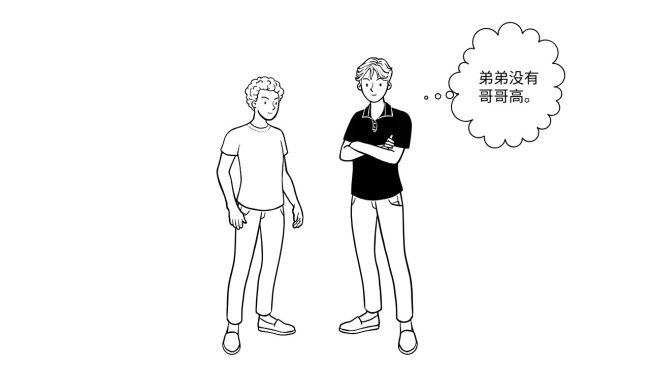
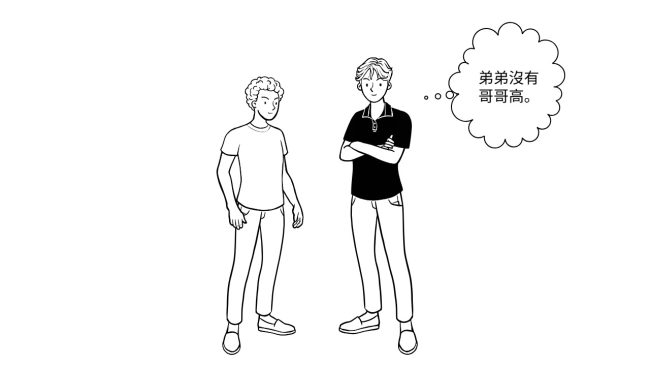
Méi yǒu 没有/沒有 express unequal comparison of inferiority. You can say that A is inferior to B by placing méi yǒu 没有/沒有 between A and B. This pattern indicates that ‘A is not as . . . as B’.
To emphasise the comparison méi yǒu 没有/沒有 is often used together with one of the demonstrative pronouns zhème 這麼 ‘so; like this’ or nàme 那麼 ‘so; like that’, implying that the second thing or person in the comparison is already strong in the quality compared.
Whether you use zhème 这么/這麼 ‘so; like this’ or nàme 那麼/那么‘so; like that’ follow the same general principles as the use of zhè 这/這 ’this’ and nà 那 ’that’. The choice depends on the relative proximity or distance, either physical, temporal, or psychological of item B, which serves as the standard of comparison.
If A and B have a modified noun in common, B is usually shortened, and the noun is left out. In the following example diànnǎo 电脑/電腦 can be omitted from B.
If a modified noun that occurs in both A and B is already known in the context, the noun can be omitted in both A and B.
Note that in spoken Chinese, the verb yǒu 有 is often omitted, especially in casual contexts and when paired with nàme 那么/那麼 or zhème 这么/這麼.
Question
To form a yes-no question, simply put the question particle ma 吗/嗎 at the end of the sentence.
Comparisons with méi yǒu 没有/沒有 are already negative, so this pattern is typically not used with affirmative-negative structure.
With adverbs
Degree adverbs such as hěn 很 ‘very’, fēicháng 非常 ‘very’ or tài 太 ‘very’ cannot be used in comparisons with méi yǒu 没有/沒有. Instead, the comparison is often emphasised with one of the demonstrative pronouns, zhème 这么/這麼 ‘so; like this’ or nàme 那么/那麼 ‘so; like that’, functioning as a degree adverbial – see structures above.
Adverbs such dōu 都 ‘all; both’ and yě 也 ‘also’ are placed before méi yǒu 没有/沒有.
Functions
Méi yǒu 没有/沒有 expressing absolute inferiority
A comparison with méi yǒu 没有/沒有 shows that A is inferior to B. It is often implied that A comes out worse in the comparison than expected.
Méi yǒu 没有/沒有 indicates the opposite of a comparison with the preposition bǐ 比 ‘to compare with/to’ and is often used to negate a comparison with bǐ 比.
The above comparative sentence with bǐ 比 can be negate simply by replacing bǐ 比 with méi yǒu 没有/沒有.
Also check: comparison with the preposition bǐ 比
Zhème 这么/這麼 ‘so; like this’ or nàme 那么/那麼 ‘so; like that’ are often placed before the feature being compared to emphasise that B is already strong in this feature.
The interrogative form is typically used to ask for confirmation or denial of an assumed inequality, typically implying expectation of a negative answer.