

 en
en cs
cs da
da de
de it
it pl
plBǐ 比 ‘to compare with/to’ is a preposition used to make comparisons of difference and disparity, like the English ‘more than’.
Structure
Basic form
With an adjective
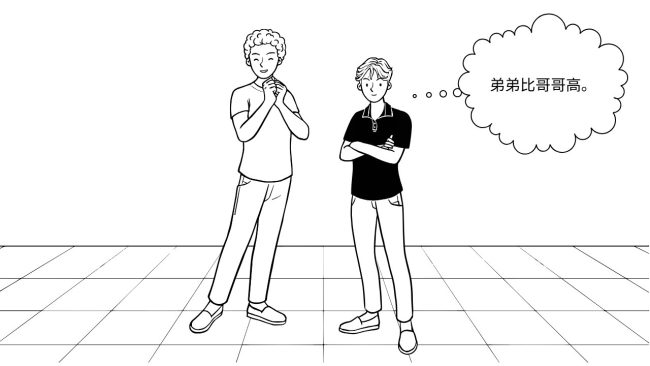
To say that A is more than B, bǐ 比 is placed between A and B. The adjective indicates the feature according to which two objects are compared and is placed after B.
If A and B have a modified noun in common, B is usually shortened, and the noun is left out. In the following example diànnǎo 电脑/電腦 can be omitted from B.
If the modified noun that occurs in both A and B is already known in the context, the noun can be omitted in both A and B.
With an adjective and a quantitative complement
To specify the difference in the compared feature the adjective is followed by a quantitative complement. The complement can indicate either a precise or a vague difference.
To indicate a precise difference, place a numeral and measure word after the adjective.
To indicate a vague difference, use a quantitative complement, such as yìdiǎn(r) 一点(儿)/一點(兒) ‘a little’, yìxiē 一些 ‘a little, slightly’, duō le 多了’much’ or de duō 得多 ‘much.
Negation
There are two ways to negate a comparison with bǐ 比. These two ways have slightly different connotations.
The most common way is to replace bǐ 比 with méi yǒu 没有/沒有. This structure indicates that ‘A is not as . . . as B’, that is, A is inferior to B in the comparison.
Also check: comparison with méi yǒu 沒有
Another way is to use the negation adverb bù 不. The negation adverb must be placed in front of bǐ 比, not the adjective. This structure indicates that ‘A is not more … than B’, indicating that A is the same or less than B in the comparison. Note that bù bǐ 不比 carries a tone of refutation.
Question
To form a yes-no question, simply put the question particle ma 吗/嗎 at the end of the sentence.
With adverbs
Degree adverbs such as hěn 很 ‘very’, fēicháng 非常 ‘very’ or tài 太 ‘very’ cannot be used in a sentence with bǐ 比.
However, the adverbs gèng 更 and hái 还/還 can be placed before the adjective to indicate the A possesses ‘even more, more than’ of the feature compared than B. Gèng 更 and hái 还/還 have slightly different connotations. Gèng 更 simply indicates that A has a higher degree of the quality than B. It is a neutral, factual statement. Hái 还/還 implies that B already has a high degree of the quality, but A surpasses it. It can add a sense of emphasis or surprise. B can be a person, thing, or even a well-known standard.
Adverbs like yě 也 ‘also’ and dōu 都 ‘all; both’ can be placed before bǐ 比.
Functions
1. Bǐ 比 expressing comparison of difference or disparity
Bǐ 比 ‘to compare with/to’ can compare the difference or disparity of people or things, describe changes in different situations and indicate changes over time.
Comparisons with bǐ 比 express a difference in property such as quality or characteristics, like the English ‘more than’. The first thing mentioned is always the one who possesses more of the feature being compared.
2. Bǐ 比 expressing ‘even more, more than’
If gèng 更 or hái 还/還 is placed in front of the feature being compared, the meaning ‘even more, more than’ is added to the comparison. Here both parts of the comparison possess the property being compared, but the first part possesses more than the second.
3. Bǐ 比 expressing a precise difference or disparity
To measure a precise difference e.g. in price, time, height or weight, a numeral and measure word is placed after the feature being compared.
4. Bǐ 比 expressing a vague difference or disparity
To measure a vague difference, such as ‘a little’ or ‘much’, a quantitative complement, such as yìdiǎn(r) 一点(儿)/一點(兒) ‘a little’, yìxiē 一些 ‘a little, slightly’, duō le 多了’much’ or de duō 得多 ‘much’, can be placed after the feature being compared.
Note, that a degree adverb with a similar connotation, such as hěn 很 ‘very’ or yǒu yìdiǎnr 有一点儿 ‘a little’ cannot be used.