

 en
en cs
cs da
da de
de it
it pl
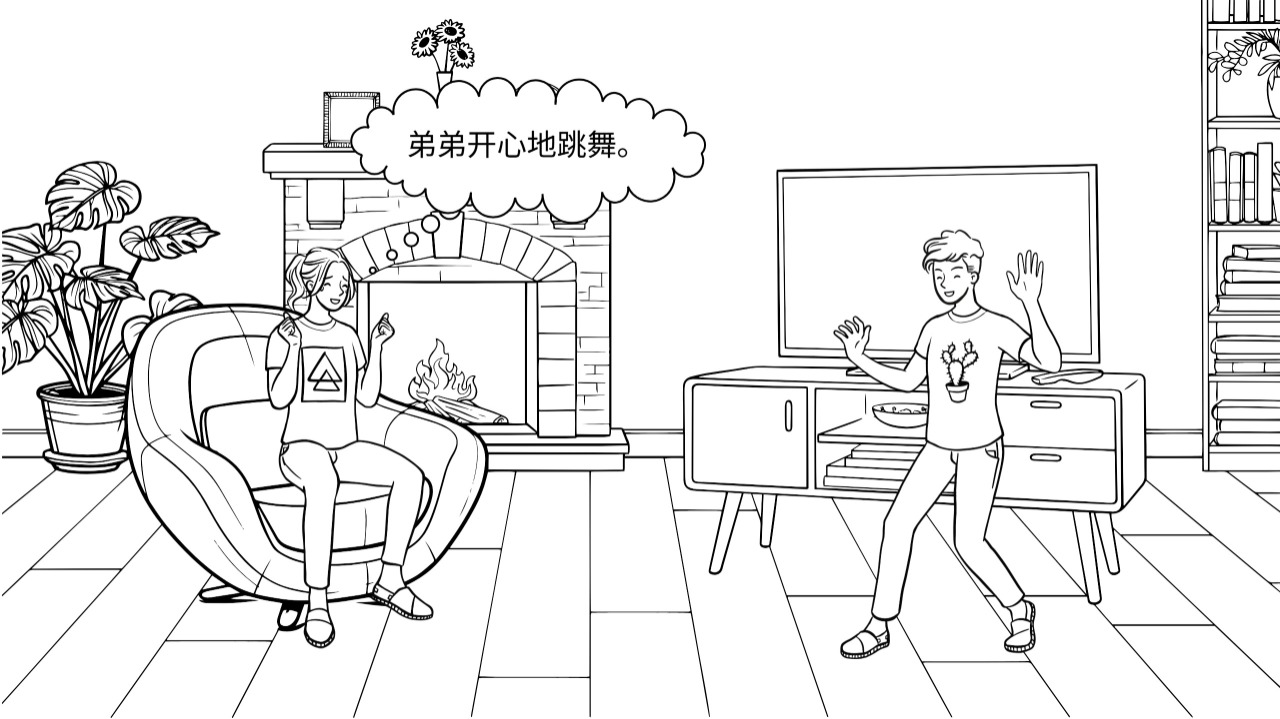
plThe structural particle de 地 is a word with grammatical function only; it has no lexical meaning. It is a particle that connects an adverbial modifier with a verb or adjective, which usually serve as a predicate of a sentence. The adverbial modifiers preceding de 地 are most frequently adjectives, but it can also be a verb, a noun, a numeral, or an idiomatic expression. It is used with adverbials which describe the appearance or mental state of the subject or which describe the manner of an action.
Structure
Basic form
De 地 stands between the adverbial modifier and the verb or the adjective.
Negation
The adverbial modifier can also be expressed by a phrase consisting of the negation adverb
bù 不 ‘not’ and an adjective.
Question
The question particle ma 吗/嗎 is placed at the end of the sentence to form a yes-no question.
With a prepositional phrase
When there is a prepositional phrase in the sentence modifying the predicate, the position of an adverbial modifier + de 地 and the prepositional phrase vary depending on the context.
In some sentences, the prepositional phrase would follow the adverbial modifier + de 地:
In other cases, for example when the prepositional phrase refers to a place, the prepositional phrase would precede the adverbial modifier + de 地:
With adverbs
The adverbial modifier may also consist of a degree adverb + adjective compound, where the degree adverb refers to the intensity of the adjective (very quickly, too loudly). There can also be an adverb of scope referring to the subject or object (such as dōu 都 ‘all, both’), which would be placed behind the subject or the object.
Note that de 地 is not used if the adverbial has only one syllable. In this case, the monosyllabic adjective needs to be reduplicated: hǎohāo de 好好地 ‘well’, qīngqīng de 轻轻地/輕輕地 ‘gently’, mànmàn de 慢慢地 ‘slowly’. However, monosyllabic adjectives can be used directly before the verb in imperative sentences without reduplication, e.g., kuài lái 快来/快來 ‘come over quickly’, màn zǒu 慢走 ‘walk slowly – meaning good-bye’.
Omission of de 地
It is acceptable to omit de 地 after the adverbial under the following circumstances; see the examples below. However, it is never wrong to include it.
1. The adverbial is the reduplication of a numerical phrase.
2. The adverbial is the reduplication of an adjective.
3. The adverbial is an often-used disyllabic adjective.
4. The adverbial is 很 + adjective.
Functions
1. De 地 with adverbials describing the appearance or mental state of the subject
De 地 occurs with adverbials that describe the attitude, expression, gesture, or state of mind of the subject when carrying out the action.
2. De 地 with adverbials describing the manner of an action
De 地 also occurs with adverbials that describe how the action of the verb is carried out.