

 en
en cs
cs da
da de
de it
it pl
plZhe 着/著 is an aspectual particle, which follows the verb in a sentence. It is used to express the existence in a place or to describe a persistent state resulting from the action of the verb, an action in progress or an accompanying action. When describing an accompanying action, zhe 着/著 follows the first verb in the sentence.

Structure
Basic form
When expressing existence in a place or describing a persistent state or an action in progress, zhe 着/著 follows the main verb in a sentence. When describing an accompanying action, zhe 着/著 follows the first verb in the sentence, not the main one.
In sentences with separable verbs, zhe 着/著 is placed directly after the verb and before the object. Separable verbs are a specific group of disyllabic verbs where the two elements can be split because the first element is typically a verb indicating an action, while the second one is often a noun representing the object of that action. Examples of such verbs include chī fàn 吃饭/吃飯 ‘to eat’, jiàn miàn 见面/見面 ‘to meet’ or shuì jiào 睡觉/睡覺 ‘to sleep’.
Expression of existence in a place
Description of an action in progress
Description of a persistent state resulting from the action of the verb
Description of an accompanying action
Negation
Sentences with zhe 着/著 are negated using méi 没/沒. For added emphasis, méiyǒu 没有/沒有 can also be used in place of méi 没/沒.
Note that the negative form is usually used to contradict the listener’s statement in dialogues.
Questions
There are three common ways to form a question with zhe 着/著:
- adding méi yǒu 没有/沒有 at the end of the sentence;
- adding the question particle ma 吗/嗎 at the end of the sentence;
- adding shì bu shì 是不是 in front of the verb followed by zhe 着/著.
In all these three types of interrogative sentences, the aspectual particle zhe 着/著 is placed after the main verb.
With adverbs
When zhe 着/著 describes an action in progress, the verbs are often preceded by the adverbs zài 在, zhèng 正 and zhèngzài 正在, which convey the meaning of ‘being in the process of’. The adverbs hái 还/還 ‘still’ and yìzhí 一直 ‘continuously, always’ can also be used to emphasize the duration of an ongoing action or a persistent state. In such cases, the final particle ne 呢 may occur at the end of the sentence.
If the verb is preceded by an adverb and the aspectual particle zhe 着/著 and the final particle ne 呢 are both used in the same sentence, the speaker is giving a strong emphasis on the action in progress or the persistent state resulting from the action of the verb.
Functions
1. Zhe 着/著 expressing existence in a place
Zhe 着/著 can be used in sentences indicating the existence or presence of somebody or something, similar to the English ‘there is/are…’, and it emphasises the ongoing duration of the situation. These sentences starts with a place, and there is only a limited number of verbs which can be used in such sentences, such as zhàn 站 ‘to stand up’, zuò 坐 ‘to sit’, shuì 睡 ‘to sleep’, fàng 放 ‘to place’, xiě 写/寫 ‘to write’ and ná 拿 ‘to hold’. These verbs express a transition from an action (e.g. writing a poem) to a state (e.g. the poem remains written there).
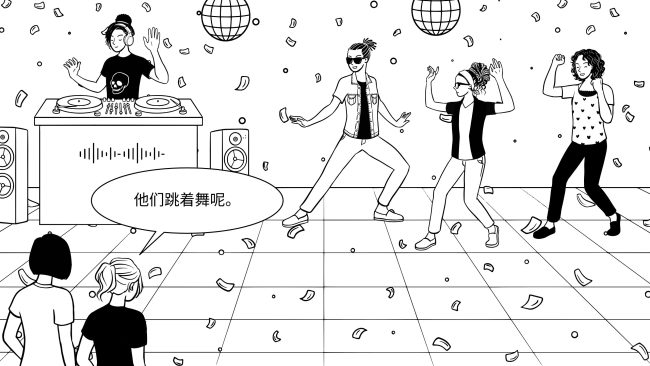
2. Zhe 着/著 describing an action in progress
Zhe 着/著 can be used to describe an ongoing action referring to the past, present or future. It always co-occurs with the adverbs zài 在, zhèng 正 or zhèngzài 正在 ‘in the process of’.
These adverbs slightly differ in their meaning:
- zài 在 emphasizes that an action or state continues,
- zhèng 正 emphasizes the moment in which the action in progress takes place,
- zhèngzài 正在 emphasizes both the time and status of an ongoing action or state.
In such cases, the particle ne 呢 may occur at the end of the sentence to emphasize the progress of the action.
Note that if zhe 着/著 describes an action in progress, it should be paired with one of these adverbs. Otherwise, the sentence could be perceived as incomplete.
Also check The progressive aspect marker 在
3. Zhe 着/著 describing a persistent state resulting from the action of the verb
Zhe 着/著 is often used to describe a persistent state resulting from the action of the verb. Sometimes, the particle ne 呢 may occur at the end of the sentence to explicitly remind the listener to foreground a certain fact.
Note that zhe 着/著 cannot be used with verbs not indicating duration. It is usually not used with verbs describing a state like shì 是 ‘to be’. However, there are a few exceptions. If some verbs describing a state are preceded by the adverbs zài 在, zhèng 正, zhèngzài 正在 ‘in the process of’ or yìzhí 一直 ‘continuously, always’, they can be paired with zhe 着/著. Examples of such verbs include bìng 病 ‘to be sick’, è 饿/餓 ‘to be hungry’, kùn 困 ‘to be tired’, zuì 醉 ‘to be drunk’, ài 爱/愛 ‘to love’ and hèn 恨 ‘to hate’.
4. Zhe 着/著 describing an accompanying action
Zhe 着/著 can be used to describe an action that takes place at the same time as another action. Usually, the first action followed by zhe 着/著 describes the manner or state of the second one, which is actually the main action of the sentence.
Sometimes, while the first action followed by zhe 着/著 indicates the manner or state of the second one, the second action expresses the reason or purpose of the first one.