
 en
en cs
cs da
da de
de it
it pl
plThe adverb jiù 就 can serve several functions in a sentence, and its meaning depends heavily on context. It may express temporal sequence meaning ‘right after’, limited quantity meaning ‘only’, restriction of scope meaning ‘just’, emphasis meaning ‘right, precisely’, or correlation between hypothetical clauses meaning ‘then’.
Structure
Basic form
Across different meanings and contexts, jiù 就 typically appears before the verb.
A succession of two events
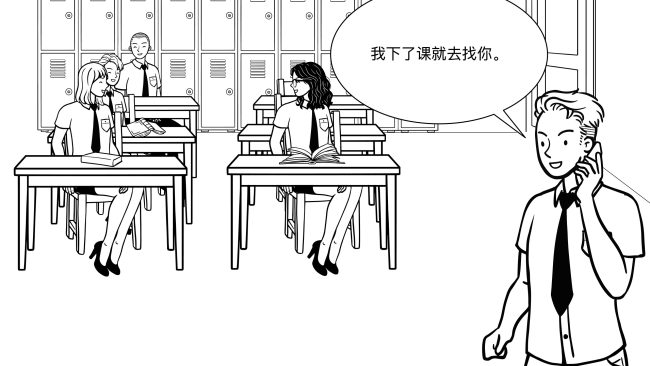
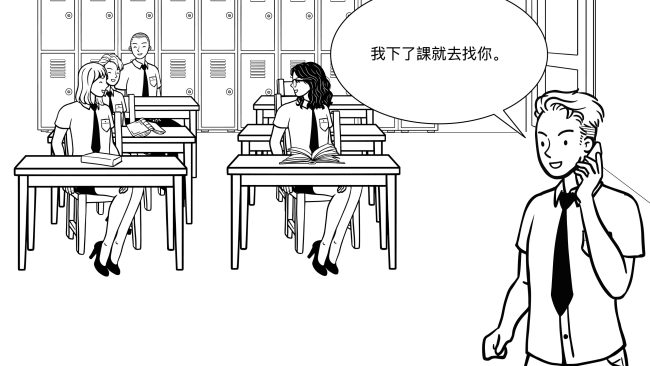
When jiù 就 expresses that one action happens ‘immediately after’ another, it stands between two verb phrases. The first verb phrase usually expresses a completed action, most often in the structure ‘verb + aspectual particle le 了 + object’ or with a result complement, but never as a bare verb. The second verb phrase expresses a second action, which may be either a bare verb or a verb phrase. If le 了 appears at the end of the sentence, it indicates that the second action has also already taken place.
A resulting outcome of a hypothetical situation
When jiù 就 appears in the second clause of conditional sentences, it introduces the resulting outcome of a hypothetical situation, echoing the conjunction rúguǒ 如果 ‘if’ placed in the first clause. This structure indicates that if the first clause is fulfilled, ‘then’ the second naturally follows.
An action that is about to occur early or quickly
Jiù 就 can be placed in front of a verb phrase to indicate that the action will happen very soon, often in the pattern jiù…… le 就……了 ‘be about to happen’.
An expectation mismatch
The adverb jiù 就 is used to show that the actual result is different from what the speaker expects. Its meaning depends on whether the value (e.g., duration, quantity, time, age, distance, etc.) appears before or after jiù 就 in the sentence.
A. Value before jiù 就
When a number or time expression appears before jiù 就, it shows that the value is smaller, earlier or requires less efforts than expected.
B. Value after jiù 就
When the time reference appears after jiù 就, it indicates that the speaker perceives that time as later than expected. By contrast, when a number appears after jiù 就, its interpretation as a small or large quantity depends on the context.
A delimitation or restriction of the scope of an event
Jiù 就 can also mean ‘only, just’ in the sense of limitation. In this use, it precedes the verb.
A strengthened confirmative tone
Jiù 就 can stress an assertion, especially with the verbs shì 是 ‘to be’ or zài 在 ‘to be at, in, or on (a place)’. In this case it precedes the verb.
Functions
1. Jiù 就 ‘right after’ expressing a succession of two events
Jiù 就 can indicate that two events happen in succession, implying that one action occurs or is performed ‘right after’ the completion of a first action.
A completed action often refers to something finished in the past. It can also describe an action that will be completed in the future within a sequence of events. For example, in the sentence below, pá wán shān 爬完山 ‘finish climbing the mountain’ refers to a future completed action:
When le 了 appears at the end of the sentence, it often shows that the second action has already happened. Without it, the sentence can describe a habit, a plan or a request, depending on the context.
To learn more on subsequent actions, also check Pattern yī…… jiù…… 一…… 就…… ‘as soon as…, then…; whenever…’ , then…’Comparison between the adverbs jiù 就 and cái 才
2. Jiù 就 ‘then’ expressing the resulting outcome of a hypothetical situation
Jiù 就 is used in sentence pattern with rúguǒ……, jiù…… 如果……,就…… ‘if…, then…’, which expresses that the condition stated in the first clause is sufficient for the second clause to happen.
When the condition is clear from the context, rúguǒ 如果 ‘if’ can be omitted. Even without it, jiù 就 in the second clause still creates a clear ‘if…, then…’ meaning. This shortened form is very common in spoken Chinese.
To learn more on hypothetical sentences, check Hypothetical sentences with rúguǒ……, jiù…… 如果……,就…… ‘if…, then…’ and ……dehuà, jiù…… ……的话/的話,就…… ‘if…, then… and Adverb zài 再 “again”, “some more; another”
3. Jiù…… le 就……了expressing an action that is about to occur early or quickly
Jiù 就 can also express that an action is going to happen very soon or very quickly. In this use, jiù 就 highlights the speaker’s feeling that the action requires little time or is happening almost immediately. This sense of imminence is expressed through the pattern jiù…… le 就……了 ‘be about to happen’.
In this use, jiù 就 may also appear with the modal verb yào 要. The combination ‘jiù 就 + yào 要 + verb + le了’ further emphasizes that the action is about to happen very soon, often with a sense of urgency or reminder.
To give the sentence a stronger sense of urgency or immediacy, the adverb mǎshàng 马上 ‘immediately’ can be added before jiù 就.
4. Jiù 就 expressing an expectation mismatch
Jiù 就 can also convey the speaker’s subjective judgment, feeling or attitude that a certain value, such as age, duration, or quantity, is different from what the speaker has expected earlier.
When the value appears before jiù 就, it indicates that the speaker considers, for example, an age to be younger, a duration to be shorter, a quantity as smaller, or the timing of an action as earlier than expected.
When a time reference appears after jiù 就, it indicates that the speaker perceives that time as later than expected.
By contrast, when a number appears after jiù 就, its interpretation as a small or large quantity depends heavily on the context. In this case, jiù 就 does not itself decide whether the amount is small or large, it highlights the speaker’s subjective evaluation within a given context.
5. Jiù 就 ‘only, just’ delimiting or restricting the scope of an event
Jiù 就 can be used to limit the scope of an event, and it precedes the verb. When stressed, it restricts what the verb applies to, either the object or the action itself. In this use, jiù 就 expresses ‘only, just’.
6. Jiù 就 ‘right, precisely’ expressing a strengthened confirmative tone
Jiù 就 can also express a strong confirmative or emphatic tone, often meaning ‘right’, ‘exactly’, ‘precisely’. In this use, it typically appears before verbs such as shì 是 ‘to be’ or zài ‘to be at, in, or on (a place)’, and is used to identify a person, place, or position with emphasis.
The sentence is usually simple and direct, with no elements of condition, time, or quantity before jiù 就.